[Mold Prevention in Consulate Waiting Rooms] What kind of environmental hygiene management is necessary to protect the trust of visitors and international reputation?
2026/07/05
[Mold Prevention in Consulate Waiting Rooms] What kind of environmental hygiene management is necessary to protect the trust of visitors and international reputation?
A thorough explanation of countermeasures against mold growth in waiting rooms, which can lead to a negative impression, health risks, and a decline in the value of the facility.
This is Inagaki from MIST Method® Mold Busters Sendai.
Consulates are important public facilities that handle international exchanges, visa procedures, and various consultation services, serving as international gateways visited by many people every day. Among these, the waiting room is the space where visitors spend the first long period of time, and it is an extremely important place that influences the overall impression of the facility.
However, in recent years, due to factors such as aging buildings, malfunctioning air conditioning systems, condensation, and insufficient ventilation, there has been an increase in cases of mold growth on the walls and ceilings of waiting rooms, around windows, and behind furniture. Mold is not merely an aesthetic problem. It can cause discomfort to visitors through discoloration, stains, and unpleasant odors, and can also give the impression that "facility management is inadequate" or "there are concerns about hygiene management."
Consulates, in particular, are facilities used by foreign visitors and diplomatic personnel, so the environmental quality of their waiting areas directly impacts the facility's credibility and reputation. In this age where even a small amount of mold can spread through social media posts and word-of-mouth, minor hygiene issues can easily escalate into major credibility problems.
Furthermore, neglecting mold not only increases health risks such as allergic reactions, coughs, and asthma due to the dispersal of spores into the air, but also causes damage to the building itself, such as peeling or lifting of wallpaper, deterioration of plasterboard, and wood rot. As a result, large-scale repair work and equipment replacement become necessary, leading to increased maintenance costs.
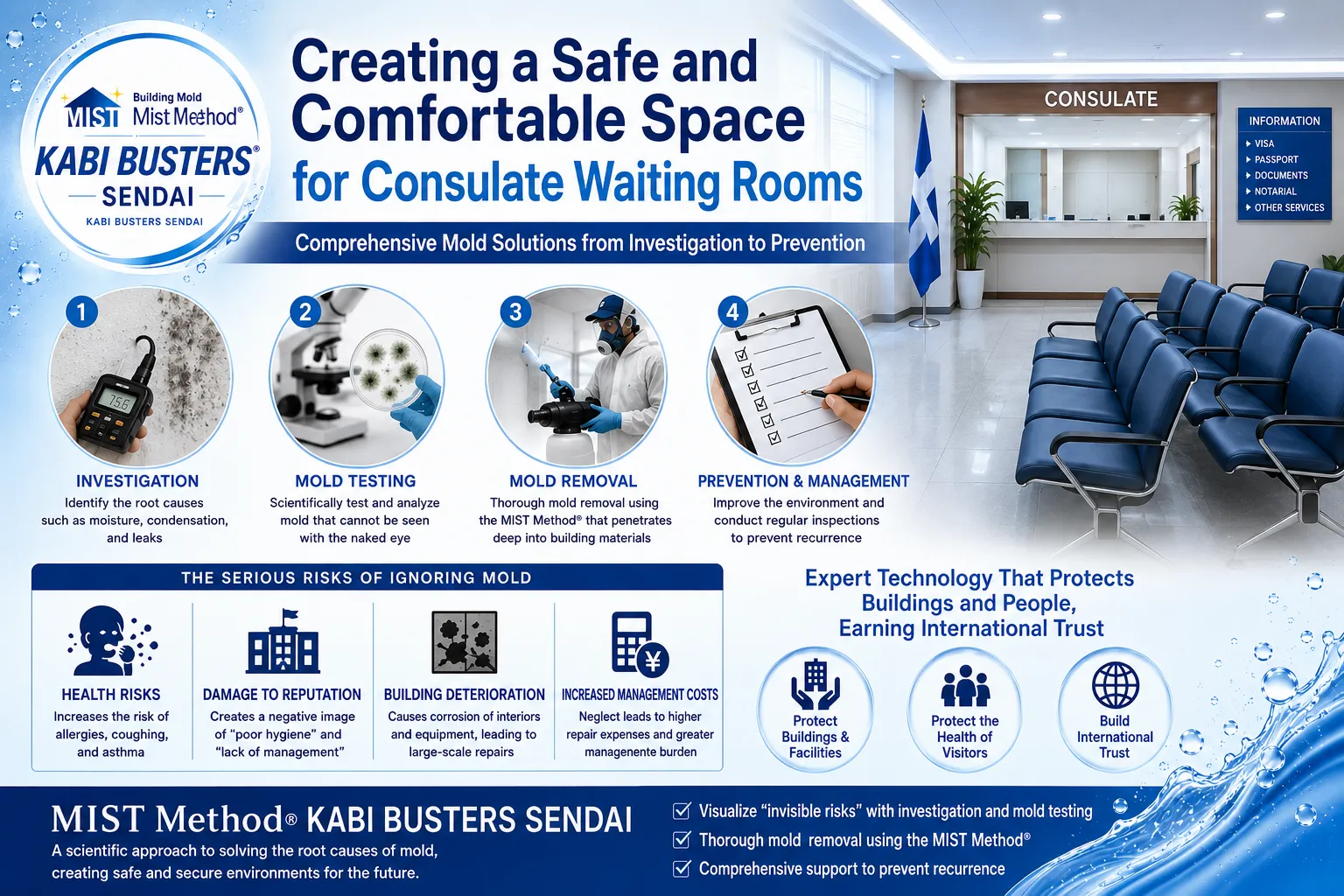
Government facilities and facilities affiliated with international organizations require responses based on appropriate standards for hygiene management and building maintenance. Therefore, it is important to implement comprehensive measures that go beyond simply removing visible mold, including investigating the cause of the mold growth, assessing the extent of fungal contamination, performing mold removal work, and managing measures to prevent recurrence.
This article will provide a detailed explanation of the causes of mold growth in consulate waiting rooms, the secondary damage caused by negative visitor perceptions, the impact on buildings and users, and the necessary management methods to prevent recurrence. We hope this information will be useful for those responsible for maintaining consulate facilities and for managing public facilities.
目次
1. What is the mold problem occurring in consulate waiting rooms?
Waiting room environment significantly impacts the first impression of diplomatic facilities: Why invisible mold contamination can damage trust.
Consulates serve as international gateways visited by many people, including foreign residents, those planning to travel abroad, business representatives, and international students. The waiting area, in particular, is a crucial space where visitors first enter and wait their turn for procedures or consultations. Much of a visitor's first impression—including reception service, cleanliness, and air quality—is formed in the waiting area, so the environmental quality of this space significantly impacts the overall perception of the consulate.
However, in recent years, due to factors such as aging buildings, deterioration of air conditioning equipment, condensation, and insufficient ventilation, cases of mold growth in waiting rooms have been increasing. In particular, in regions with large temperature differences between winter and summer, such as the Tohoku region, condensation is likely to occur around windows, on exterior walls, in the ceiling space, and near air conditioning vents, which can lead to mold growth.
Mold problems aren't just limited to black stains on walls and ceilings. Visible mold is often just the tip of the iceberg; in reality, fungi are often growing inside walls, ceilings, and air conditioning systems. Even if it looks like just a little dirt on the surface, a large number of spores may be floating in the air.
Waiting rooms are used by a large number of visitors. Since they are used by the elderly, young children, pregnant women, and people with underlying health conditions, maintaining a hygienic environment is extremely important. Mold spores floating in the air can trigger allergic reactions, coughs, rhinitis, and other symptoms, potentially compromising the comfort of facility users.
Furthermore, given the nature of a consulate, the environment of the waiting room is not merely a matter of building maintenance. If visitors notice a musty smell or see blackening on the walls and ceilings, they may get the impression that "facility management is inadequate" or "there are problems with hygiene management." This not only lowers user satisfaction but also affects trust in the facility as a whole.
In today's world, with the widespread use of social media and review sites, any unpleasant impressions experienced within a facility can spread instantly. If mold or unpleasant odors in a waiting room are posted online with photos, that information will spread rapidly and be seen by many people. As a consulate serves as an international gateway, such negative impressions can affect not only the facility's credibility but also the evaluation of its services to users.
Furthermore, if mold growth is left untreated, it can spread to the building itself, causing serious damage. This can lead to peeling and discoloration of wallpaper, deterioration of plasterboard, and decay of wood, eventually requiring extensive renovation work. Problems that could be addressed with relatively minor measures in the early stages can easily escalate into facility management issues requiring costly repairs a few years later.
Mold problems in consulate waiting rooms are not just an aesthetic issue; they are a critical concern affecting visitor health, facility reliability, the quality of administrative services, and the longevity of the building. Therefore, it is necessary to go beyond superficial cleaning and instead identify the cause of the mold growth, investigate the internal conditions of the building, and implement appropriate mold removal measures and preventative management to prevent recurrence.
As a consulate serving as a point of contact with the international community, it is crucial to maintain a clean and comfortable waiting environment that visitors can use with peace of mind. Early detection of mold contamination progressing in unseen areas and taking appropriate measures is the first step in protecting the credibility and value of the facility.
タイトル
The unique humidity pitfalls of consulate environments: The reality of building environments that lead to mold growth.
The mold problem in consulate waiting rooms is not simply due to insufficient cleaning. In reality, it is caused by a combination of factors, including the building structure, air conditioning, ventilation, and usage environment. The blackening and stains visible on the surface are merely the result; in many cases, underlying issues include moisture, condensation, and poor air circulation that have accumulated over a long period.
Consulates, in particular, differ from typical offices and commercial facilities in that many visitors stay for extended periods. Waiting times are incurred for visa applications, issuance of various certificates, and consultation services, so waiting rooms tend to be crowded. When people gather, the humidity inside increases due to their breath and body heat. Furthermore, on rainy days, a large amount of moisture is brought in from wet clothing and umbrellas, so the humidity level in waiting rooms can become much higher than expected.
One of the biggest causes of mold growth is condensation.
Condensation is a phenomenon in which water vapor in the air turns into water droplets when it comes into contact with a cold surface. During winter heating operation, window panes and exterior walls are cooled, and condensation occurs due to the temperature difference between the inside and outside. Conversely, in summer, condensation may occur around air conditioning vents and pipes that have been cooled by air conditioning.
Consulate waiting rooms often feature large windows, and the areas around these windows, which are easily affected by outside air, are prone to condensation. The condensation that forms on the rubber gaskets of window frames, the back of curtains, and windowsills creates an ideal environment for mold to grow.
Furthermore, the issue of air conditioning management cannot be overlooked.
Because waiting rooms are used by many people, heating and cooling are run for long periods of time to prioritize comfort. However, if the filters of the air conditioning system become dirty or the internal components become contaminated, the efficiency of air circulation decreases, and the temperature and humidity balance inside the room is disrupted.
Furthermore, if condensation occurs inside the air conditioning system, moisture can accumulate around the drain pan and heat exchanger, leading to mold growth. If the system continues to operate in this condition, the airflow from the air conditioner could spread mold spores throughout the waiting room.
If you notice a musty smell in a waiting room, the cause is often located inside the air conditioning system.
Insufficient ventilation is also a major factor that accelerates mold growth.
Modern buildings are highly airtight to improve energy efficiency. While improved airtightness is not inherently bad, if adequate ventilation is not provided, moisture tends to accumulate indoors.
In consulates, where security is a particular priority, opening windows may be restricted. As a result, moisture that accumulates indoors is less likely to escape, making it easier for mold to grow in places where air stagnates, such as on walls, in ceilings, and behind furniture.
Areas like sofas, partitions, and the backs of bulletin boards in waiting rooms have poor air circulation, making it easy for mold to go unnoticed for a long time. Mold that grows in places that are not easily seen by users can gradually spread and eventually affect the entire room.
The aging of the building is also a serious contributing factor.
In older buildings, rainwater can seep in through deterioration of the waterproofing layer, cracks in the sealant, and cracks in the exterior walls. Even without visible leaks, small amounts of moisture can accumulate inside the walls and ceilings, creating an environment where mold can thrive.
Furthermore, there are cases where the effects of past water leaks or plumbing problems remain. Even if the surface has been repaired, if moisture remains inside, mold can continue to grow for a long period of time.
Waiting rooms, in particular, are spaces where the safety and comfort of users are paramount, making it difficult to detect mold growth even if it is progressing in areas hidden by interior materials.
Furthermore, in recent years, climate change has led to an increase in heavy rainfall and high humidity. In the Tohoku region, humidity inside buildings tends to rise during the rainy season and due to the influence of the autumn rain front, making humidity control more important than ever.
As you can see, mold in consulate waiting rooms doesn't occur due to a single cause. It's caused by a complex interplay of factors including condensation, air conditioning management, insufficient ventilation, building deterioration, usage environment, and climatic conditions.
Therefore, simply removing visible mold will not provide a fundamental solution. Accurately investigating the cause of the mold growth, understanding the source of moisture and the conditions inside the building, and then implementing countermeasures is essential to prevent recurrence. Because a consulate is a facility that combines public and international characteristics, appropriate mold control measures based on thorough investigation of the cause are particularly required.
タイトル
Waiting room environment that affects the credibility of a consulate: How even a small amount of mold can lead to a decline in international reputation
The mold problem in consulate waiting rooms is not merely a building management issue. Rather, the most serious issue is the invisible secondary damage caused by the negative impression it leaves on visitors. Mold on walls and ceilings, a musty smell in the room, and stains and discoloration caused by condensation leave a stronger impression on visitors than facility managers might imagine. And that impression can affect not only the credibility of the facility itself, but also the credibility of the country or organization that the consulate represents.
Consulates are international administrative windows that handle visa applications, issuance of various certificates, residency procedures, and consultation services. Visitors include not only citizens of the country but also foreign residents, those planning to travel abroad, business representatives, international students, and diplomatic personnel. Therefore, the waiting area is not merely a place to wait, but a space that symbolizes the attitude and quality of the country or organization.
Visitors unconsciously observe their surroundings from the moment they enter a facility. They evaluate the entire facility based on various pieces of information, such as the reception staff's service, the cleanliness of the place, the smell of the air, the condition of the walls and ceilings, and the cleanliness of the chairs and equipment. Among these, the presence of mold is very noticeable and has the characteristic of easily causing discomfort to people.
For example, if there is discoloration on the walls of the waiting room or mold growth around the windows, many visitors will feel that the facility is not being properly maintained. Even if daily cleaning is actually being carried out appropriately, the mere visual presence of mold can give the impression of inadequate management.
Furthermore, the distinctive odor of mold leaves a stronger impression than visual cues. Humans instinctively tend to perceive odors as dangerous or unsanitary. Therefore, if someone smells mold the moment they enter a waiting room, it is likely to lead to the impression that "the hygiene is poor" or "there are problems with the air quality."
Many visitors to consulates experience long wait times. The longer the wait, the more conscious they become of the indoor environment, and the greater their discomfort. As a result, issues with the facility environment, which are unrelated to the procedures themselves, can escalate into dissatisfaction with the overall service.
In recent years, with the spread of social media and review sites, impressions of facilities are instantly shared with society.
"The waiting room smelled musty."
"I saw black mold on the wall."
"I was worried about hygiene management."
If such posts are shared with accompanying photos, the information can spread widely in a short period of time. Even people who have not actually used the facility may form a negative impression of the facility as a whole based on that information.
In the case of consulates, this impact is greater than in typical private facilities because consulates are recognized as international public institutions. An impression of unsanitary conditions experienced by visitors can develop not only into a "problem with facility management," but also into questions about the "overall management system of the organization" and the "quality of administrative services."
For visitors, especially those from abroad, a consulate is one of the few places where they can directly experience a country. The environment of the waiting room can sometimes be seen as a symbol of the country's hygiene awareness and management standards. Therefore, a negative impression caused by mold can lead to a much greater decline in its reputation than one might imagine.
Furthermore, mold problems affect not only facility users but also staff morale. If staff members who work every day continue to work in a moldy, damp environment, their comfort and satisfaction with the work environment may decrease. If the staff members who interact with visitors feel uneasy about the facility's environment, that atmosphere will be conveyed to the users.
Furthermore, for facility managers, neglecting mold problems can lead to increased complaints and accountability in the future. Dealing with visitor complaints and requests for environmental improvements requires significant time and effort beyond their regular duties.
To prevent such situations, it is crucial to recognize mold not merely as dirt, but as a significant risk affecting the reliability and reputation of a facility. Especially in international public facilities such as consulates, maintaining a hygienic environment is part of the user service and a vital element in supporting the organization's credibility.
Even a small amount of mold in a waiting room can have far-reaching consequences beyond the building's interior. It can lead to various secondary damages, such as a negative impression on visitors, the spread of negative rumors through word of mouth, distrust of administrative services, and a decline in international reputation. That's why early detection of mold, appropriate countermeasures, and continuous preventative management are essential for protecting the consulate's credibility and dignity.
タイトル
The impact of invisible airborne mold contamination on users | To protect a safe and comfortable waiting environment
The mold problem in consulate waiting rooms is not just an aesthetic or facility evaluation issue. More serious is the potential for mold spores released into the air to affect the health of users and staff. Especially in consulates, which are used by a wide range of people from children to the elderly, the safety of the air environment is an extremely important management item.
Mold can appear as black stains on walls, ceilings, and around windows, but the problem isn't limited to what's visible. As mold grows, it releases tiny particles called spores into the air. These spores are so small that they are invisible to the naked eye, and people may inhale them without realizing it.
Many people stay in waiting rooms for extended periods. Long waits are not uncommon for visa applications, certificate issuance procedures, and consultation services. Therefore, in environments where mold spores are present in the air, users may be continuously exposed to them.
One of the most common health effects caused by mold spores is allergic reactions.
Symptoms such as runny nose, nasal congestion, sneezing, and itchy eyes can appear in a similar way to hay fever. Those with a pre-existing allergic constitution or weakened immune systems may experience more severe symptoms, which can lead to feeling unwell while using the facility.
Additionally, coughing and a sore throat are also common symptoms seen in mold-contaminated environments.
Complaints such as coughing upon entering a waiting room, a scratchy throat after prolonged stays, or a feeling that the air is heavy may be related to poor air quality. In particular, poorly ventilated environments tend to accumulate spores and microorganism-derived substances, leading to a decline in indoor air quality.
The impact on people with asthma cannot be ignored.
Asthma sufferers are sensitive to airborne irritants, and inhaling mold spores can trigger an asthma attack. Children with asthma and older adults with respiratory illnesses tend to be more susceptible than the general population.
Consulates are facilities used by a diverse range of people, including not only local residents but also visitors from overseas, international students, and foreign workers. Because this group includes people with chronic illnesses, pregnant women, and the elderly, a greater attention to air quality is required than in a typical office.
Another problem is the unpleasant smell caused by mold.
Mold growth can produce a distinctive odor. While this odor may not directly cause health problems, it can be very stressful for users.
For visitors spending long periods in waiting rooms, unpleasant odors can be a mental burden, leading to feelings of anxiety such as "I want to leave this place as soon as possible" or "Is this facility unsanitary?". Especially for those visiting for important procedures or consultations, an unpleasant waiting environment can negatively impact their overall evaluation of the facility.
Furthermore, the impact on staff members cannot be overlooked.
Staff working in waiting rooms and around service counters spend long hours each day in those spaces, not just a few hours a day. Because they are exposed to mold for longer periods than users, this can lead to complaints of chronic rhinitis, coughs, headaches, and fatigue.
A deteriorating work environment will affect operational efficiency and customer service quality. As a result, the quality of visitor services may decline, potentially leading to a negative overall evaluation of the facility.
Furthermore, in environments where mold is present, the air quality itself deteriorates.
In recent years, "Indoor Air Quality (IAQ)" has become an important factor in building management. Air quality refers not only to temperature and humidity, but also to the overall air environment, including airborne dust, microorganisms, and odors.
When the air quality in a waiting room deteriorates, users may unconsciously experience discomfort and fatigue. Because it is an invisible problem, the cause is often difficult to pinpoint, and in many cases, people simply feel "uncomfortable" or "the air is heavy."
Consulates serve as important gateways for international exchange and administrative services. Maintaining a safe and secure environment for visitors is fundamental to facility management and directly contributes to improving the quality of services provided to users.
Therefore, it is important to view mold problems not merely as an aesthetic issue, but as a health risk and an issue of air quality. By understanding not only visible mold, but also airborne bacteria and the level of contamination inside buildings, and by implementing appropriate investigations and countermeasures, it is possible to maintain a safe and comfortable waiting environment.
To protect the health of both visitors and staff, and to maintain the credibility of the consulate, comprehensive mold control measures, including air quality management, are required.
タイトル
Small molds can trigger major repairs | The reality of building deterioration that threatens the asset value and maintenance costs of consulate facilities
Ignoring mold in a consulate waiting room because it's "just a cosmetic issue" or "doesn't affect usability" could eventually lead to deterioration of the entire building. Mold is not just dirt; it's a warning sign of internal building problems such as dampness, condensation, and moisture buildup. Therefore, neglecting surface mold is tantamount to neglecting the root cause of the building's deterioration.
Especially in facilities that combine public and international characteristics, such as consulates, the level of building maintenance directly impacts how users perceive the facility. The waiting room is the first space visitors use, and its environmental quality influences the overall impression of the facility. However, the damage caused by neglecting mold is not limited to just a deterioration in appearance.
The first thing that is likely to occur is peeling or discoloration of the wallpaper.
When wallpaper absorbs moisture, its adhesive strength weakens, and it gradually starts to lift or peel. In particular, in areas prone to condensation, such as exterior walls, around windows, and near air conditioning vents, mold is often found growing on the back of the wallpaper.
Even if there are only slight discolorations or stains on the surface, removing the wallpaper may reveal that mold has spread throughout the entire plasterboard. At this stage, partial repairs are no longer sufficient, and it may be necessary to replace the entire wall covering.
Even more serious is the corrosion of interior materials.
In environments where mold thrives, moisture is constantly supplied. If this condition persists for a long period, gypsum board and wooden subflooring will continue to absorb moisture.
Gypsum board can lose strength due to moisture, leading to crumbling and deformation. In addition, wood components can become susceptible to fungal growth, potentially causing the structural materials themselves to deteriorate.
When this kind of deterioration progresses inside the walls and ceilings of a waiting room, even if it's not visible to the naked eye, serious damage can be spreading throughout the building.
Consulates, in particular, have numerous security, communication, and information management systems installed. The effects of mold and humidity are not limited to interior materials.
Damage to equipment is also a significant issue.
When mold grows inside air conditioning equipment, the contamination can spread to heat exchangers, drain pans, and airflow paths. This can reduce air conditioning efficiency and lead to increased energy consumption.
Furthermore, humid environments raise concerns about the impact on electrical equipment. Condensation occurring at wiring connections and inside control panels can lead to corrosion and poor contact.
Consulates operate numerous critical pieces of equipment, including counter management systems, surveillance cameras, and security systems. If these systems malfunction, it could not only incur repair costs but also disrupt administrative services and the operation of the facility itself.
A further problem is the potential for damage to spread to the ceiling space and inside the walls.
Mold will continue to grow as long as moisture is present. Even if you clean only the surface, if the cause remains inside the walls or ceiling, it will recur repeatedly.
As time passes, the scope of the damage expands, and eventually, it can affect not only the waiting room but also surrounding offices, corridors, and conference rooms.
It's not uncommon for damage that initially covers only a few square meters to escalate into extensive repair work covering tens of square meters a few years later.
In situations like these, large-scale renovation work becomes necessary.
It's no longer just a matter of replacing the wallpaper.
Drywall replacement
Wood replacement
Ceiling demolition and restoration
Air conditioning equipment cleaning
Duct interior cleaning
Mold prevention treatment
Waterproofing repair
Ventilation system improvement
Multiple construction works may be required, such as those mentioned above.
Naturally, the cost increases as the scope of construction expands. Furthermore, facilities like consulates must continue to serve visitors even during construction, which can lead to additional costs for temporary arrangements and schedule adjustments.
Furthermore, the impact on facility usage cannot be ignored.
Restrictions on the use of the waiting room during construction would lead to a decline in visitor services and reduced operational efficiency. In some cases, it may be necessary to set up temporary waiting areas or change operating procedures, placing a significant burden on facility management staff.
This damage could have been prevented if the cause had been investigated and appropriate mold removal measures taken in the initial stages. However, by treating mold as mere dirt and neglecting to address the root cause, significant repair and maintenance costs are ultimately incurred.
Mold control in consular facilities is not only a matter of hygiene management but also a crucial maintenance task for protecting building assets. If peeling wallpaper or interior corrosion is observed, it's possible that problems are already progressing inside the building. To ensure the longevity of the facility and reduce maintenance costs, it's essential to thoroughly implement early detection and countermeasures, taking appropriate action before the damage escalates to the point of requiring large-scale renovations.
タイトル
Removing visible mold doesn't solve the problem | The real reason why mold keeps recurring at consulate facilities
If mold appears in a consulate waiting room, many facilities will first attempt to clean or wipe it down with commercially available mold removers. While this may temporarily remove the black stains from walls and window frames, giving the impression that the problem is solved, in reality, mold often reappears in the same locations a few months later or the following season.
Why do these recurrences occur?
The reason is that the visible mold is not the whole story.
Mold doesn't just grow on the surface like plants do. It can spread to places invisible to the naked eye, such as inside building materials, behind wallpaper, inside plasterboard, in ceilings, inside walls, and inside air conditioning systems. The blackening that appears on the surface is often only a part of the mold contamination progressing inside the building.
For example, let's consider a case where black mold has grown on the wallpaper in a waiting room.
Wiping the surface with a commercially available mold remover may make it look clean at first glance. However, if mold spores remain on the back of the wallpaper or inside the plasterboard, they will reappear on the surface when the humidity rises.
This is similar to how weeds will grow back if you only cut off the leaves, as long as the roots remain.
Treating only the surface will not prevent recurrence as long as the root cause remains.
Furthermore, commercially available mold removers have their limitations.
Most products intended for general household use are designed to remove surface dirt from areas such as bathrooms and window frames. Therefore, they do not have the functionality to inspect the interior of a building or to resolve the root cause of mold growth.
Furthermore, even if you bleach away the black stains with strong chemicals, it doesn't necessarily mean that the mold itself has been completely removed. Even if the appearance improves, spores and hyphae may still remain.
What's troublesome for facility managers is the phenomenon where "it looks clean on the surface, but then the problem recurs."
This is not solely due to mold spores lurking inside the building.
A source of moisture is always present behind the recurrence of the condition.
Mold will reappear repeatedly if moisture is continuously generated due to any reason, such as condensation, insufficient ventilation, water leaks, rainwater intrusion, malfunctioning air conditioning equipment, or insufficient insulation.
In other words, what really needs to be addressed is not the mold itself, but the environment that allows the mold to thrive.
Condensation is a particularly significant problem in consulate waiting rooms.
When temperature differences occur due to heating operation in winter or cooling operation in summer, condensation can form around windows, exterior walls, and air conditioning vents.
If this condition is repeated, moisture will accumulate inside the building materials, creating an environment where mold can easily grow.
No matter how much you clean with mold removers, recurrence is unavoidable unless measures are taken to prevent condensation.
Furthermore, the internal workings of air conditioning systems are often overlooked.
If mold is growing inside the air conditioner, such as on the heat exchanger, drain pan, or airflow path, spores may be released into the room each time the unit is operated.
Even if the walls of the waiting room are cleaned, if contamination remains inside the air conditioning system, spores will continue to be supplied into the air, leaving a high risk of recurrence.
Furthermore, there are also impacts due to the aging of the building.
If rainwater is seeping in due to cracks in the exterior walls, deterioration of the waterproofing layer, or damage to the sealant, mold may be growing inside the walls or in the ceiling space.
In cases like these, surface cleaning alone is completely insufficient.
Identifying the source of the problem and repairing the building will be necessary.
In public facilities such as consulates, measures that target the entire building, not just visible areas, are required to maintain the safety of users and the reliability of the facility.
Therefore, in professional mold control, investigating the cause is crucial.
Where is the moisture located?
Why did mold grow?
Are there any problems with the air conditioning system?
Is there any contamination inside the walls or ceiling?
What is the risk of recurrence?
After confirming these points, it is necessary to carry out appropriate mold removal treatment and measures to prevent recurrence.
The mold problem in the consulate waiting room is a building management issue that cannot be solved by simple cleaning. Even if the visible mold is removed, if the mold spores and sources of moisture remaining inside the building are left untreated, it is only a matter of time before the problem recurs.
To protect the health of visitors, maintain the reliability of the facility, and preserve building assets in the long term, a comprehensive mold control approach is necessary, encompassing everything from identifying the cause to preventing recurrence, rather than just superficial measures.
タイトル
Specialized measures to protect the credibility and hygiene of the consulate | Comprehensive mold management from cause investigation to prevention of recurrence.
The mold problem in consulate waiting rooms cannot be solved simply by cleaning or restoring aesthetics. As explained above, mold can cause many secondary problems, including health risks for visitors, a decline in the facility's image, building deterioration, and increased maintenance costs. Furthermore, given the nature of a consulate, its users include a wide range of people such as foreign residents, international students, business personnel, and diplomatic personnel, making the maintenance of a hygienic environment one of the important responsibilities of facility management.
At MIST Method® Mold Busters Sendai, we don't just remove visible mold; we take a comprehensive approach to mold control, focusing on "why it occurred," "how far the contamination has spread," and "what is needed to prevent recurrence."
The first and most important step is to investigate the cause.
Mold always has a cause for its growth.
Is it condensation, insufficient ventilation, a problem with the air conditioning system, a water leak, or moisture intrusion due to the building's deterioration?
Simply removing mold without identifying the cause is unlikely to prevent recurrence if the same environmental conditions remain.
In the consulate waiting room,
Condensation on the exterior wall
Moisture buildup around large windows
Contamination inside air conditioning equipment
Insufficient ventilation in the attic
Past water leakage history
These factors may be related in combination.
Therefore, it is important to understand the cause by examining the entire building environment, rather than just looking at the location where the problem occurred.
The next step is a bacterial test.
In many cases, mold cannot be identified by visual inspection alone.
They may be breeding behind walls or inside ceilings, or even if it looks clean, there may be a large number of spores floating in the air.
By conducting a bacterial test,
Presence or absence of mold contamination
Understanding the extent of contamination
Air quality
Comparison before and after improvement
This allows you to objectively verify things like that.
In highly public facilities such as consulates, it is crucial to understand the situation through numerical data and test results in order to provide a safe and secure environment for users.
Based on the results of the cause investigation and fungal testing, we will carry out mold removal treatment.
Mold can be present not only on the surface, but also inside building materials and equipment.
Therefore, simple wiping is not enough; appropriate mold removal treatment is required depending on the level of contamination.
In the waiting room,
Wall surface
ceiling
Around the window
Around the counter
Back of furniture
Around the air conditioning vent
These may be areas of contamination.
By carrying out construction while considering the facility's usage and the condition of the building materials, we aim to improve the sanitary environment while minimizing the burden on users and the facility.
However, what's truly important is what happens after construction is complete.
The mold problem isn't solved simply by removing it.
Preventing recurrence is the most important initiative in long-term facility maintenance.
In fact, in many facilities, the same problem recurs several years later because preventative measures were not taken after mold removal.
At MIST Method® Mold Busters Sendai,
humidity control
Ventilation improvement
Air conditioning management
Condensation prevention
Regular inspection
Maintenance plan
We emphasize the importance of comprehensive preventive management, including these factors.
Consulate waiting rooms, in particular, are characterized by a higher number of users and frequent comings and goings, resulting in greater fluctuations in air quality compared to typical offices.
Therefore, it is important to continue management while keeping track of seasonal environmental changes.
Furthermore, in recent years, BCP (Business Continuity Planning) and risk management aspects have also become increasingly important in facility management.
If the mold problem is left unaddressed and facility usage restrictions or large-scale renovations become necessary, it could have a significant impact on administrative services and visitor management.
Therefore, addressing problems at an early stage and continuing preventative management is crucial for stabilizing facility operations.
The consulate waiting room is where many people first come into contact with that country or organization.
Having a clean and comfortable space not only provides visitors with a sense of security, but also directly contributes to their trust in and positive evaluation of the facility.
MIST Method® Mold Busters Sendai comprehensively supports the creation of a safe and comfortable environment required for consulate waiting rooms by conducting cause investigations, fungal testing, mold removal work, and recurrence prevention management.
To protect the building, its users, and the facility's reputation, long-term mold prevention measures are crucial, going beyond mere cleaning. Maintaining a hygienic environment befitting an international public facility like a consulate is an essential aspect of future facility management.
----------------------------------------------------------------------
カビバスターズ仙台
MPソリューション株式会社
〒980-0013
宮城県仙台市青葉区花京院2-1-61
オークツリー仙台1F
電話番号 090-8957-8975
----------------------------------------------------------------------