Mold problem in Miyagi Prefecture Consulate's offices and health concerns of staff | Hygiene management in the work environment that supports international business
2026/07/04
Mold problem in Miyagi Prefecture Consulate's offices and health concerns of staff | Hygiene management in the work environment that supports international business
The impact of invisible mold contamination on diplomatic operations and comprehensive measures to prevent health damage, building deterioration, and loss of trust.
This is Inagaki from MIST Method® Mold Busters Sendai.
Miyagi Prefecture is home to important facilities that facilitate international exchanges, support foreign residents, and engage in international economic activities. Among these, the offices of consulates and international exchange-related facilities are used by many staff and visitors, requiring high levels of hygiene management and the maintenance of a safe indoor environment. However, in recent years, due to factors such as the increased airtightness of buildings, the complexity of air conditioning systems, and rising humidity caused by climate change, there has been an increase in cases of mold growth inside offices.
Mold is not merely an aesthetic problem. It can grow in unseen places such as behind wallpaper, in ceilings, inside air conditioning systems, in document storage areas, and around windows, releasing spores into the room. This can lead to health concerns among staff, including coughs, sore throats, allergy symptoms, headaches, and fatigue. Furthermore, it can have a significant impact on organizational operations, such as decreased work efficiency, increased staff absenteeism, and providing an unpleasant experience for visitors.
Consulates are facilities that are expected to uphold international trust and public responsibility. A deteriorating working environment can not only affect the health of staff but also impact the evaluation of facility management capabilities and the external impression. Furthermore, in environments where important documents, official records, and electronic equipment are stored, secondary damage such as corrosion and deterioration due to mold cannot be overlooked.
This article provides a detailed explanation of the causes and characteristics of mold problems that can occur in the offices of consulates in Miyagi Prefecture, their relationship to health concerns among staff, and the secondary damage that can result from neglecting the problem. We will also introduce the importance of preventive management and investigations that facility managers should undertake, as well as the cause investigation, fungal testing, mold removal treatment, and recurrence prevention measures implemented by MIST Method® Mold Busters Sendai.
Please read to the end to help us protect the important work environment that supports our international operations. We hope this will be helpful as a guide to maintaining the health of your staff and the reliability of our facilities.
目次
What causes mold growth in the Miyagi Prefectural Consulate's office?
The invisible moisture risk created by airtight construction, condensation, and air conditioning environments.
Consulate offices are important spaces where many staff members carry out their daily work. Because the work involves various application processes, international exchange support, and diplomatic affairs, requiring high accuracy and concentration, maintaining a comfortable and hygienic indoor environment is essential. However, in recent years, due to factors such as the increased airtightness of buildings, the operation of air conditioning systems, and the unique climate conditions of Miyagi Prefecture, cases of mold growth inside offices have been increasing.
There is always a reason for mold growth. In most cases, it is "humidity." The troublesome thing is that by the time mold appears, moisture has often already accumulated inside the building for a long period of time.
In recent years, public and international facilities have been increasingly designed with high airtightness and insulation to improve energy efficiency. While this makes them less susceptible to outside temperature changes and helps maintain comfortable room temperatures, it also means that moisture generated indoors is less likely to escape. In offices where many staff members work, even simple human respiration and sweating generate a large amount of water vapor. Furthermore, hot water supply systems, cleaning work, and the use of humidifiers also contribute to increased humidity.
Ideally, excess moisture should be removed through ventilation, but some facilities prioritize security or maintaining air conditioning efficiency, resulting in infrequent window openings. As a result, indoor moisture gradually accumulates, making condensation more likely to occur in unseen places such as inside walls and ceilings.
In Miyagi Prefecture in particular, humidity tends to be high from the rainy season through summer, and in winter, the large temperature difference between indoors and outdoors due to heating creates an environment where condensation is likely to occur. While condensation on windowpanes is relatively easy to spot, the real problem is "internal condensation" that occurs inside walls and ceilings.
Internal condensation cannot be seen from the surface of the building, so it progresses unnoticed for a long time. Moisture continues to accumulate behind insulation, around light steel frames, and on the back of gypsum boards, creating an ideal breeding environment for mold. Even if there are no visible abnormalities, it is not uncommon for mold to have already proliferated extensively behind the wallpaper.
Furthermore, air conditioning systems are a major cause of mold growth. In consulate offices, air conditioning is often in operation throughout the year, and when it is running in cooling mode, a large amount of condensation water is generated on the heat exchanger and drain pan. If this condensation water is not properly drained or if internal cleaning is insufficient, it can cause mold to grow inside the air conditioning unit.
Mold that grows inside air conditioning systems is extremely troublesome. Because the spores are spread throughout the room by the airflow, mold that has grown inside some equipment can worsen the air quality of the entire office. In cases where employees complain of unexplained coughs or sore throats, mold contamination inside the air conditioning system may actually be the cause.
Furthermore, there are many places in an office where air tends to stagnate, such as around document storage rooms, cabinets, and multifunction printers. When furniture is placed tightly against a wall, airflow is blocked, and moisture tends to accumulate between the furniture and the wall. In such environments, surface temperatures tend to drop, leading to condensation and mold growth.
Consular facilities often have a closed structure for security reasons, which tends to lead to chronic insufficient ventilation. Therefore, it is important to thoroughly manage humidity and ventilation from the stage before mold becomes visible.
Rather than dealing with mold after it appears, it is crucial to identify the moisture causing the growth and take preventative measures early. Multiple factors such as moisture retention due to airtight construction, internal condensation, condensation in air conditioning systems, and insufficient ventilation combine to create an invisible mold risk in consular offices. Regular inspections and preventative management through cause investigation are essential to protect the health of staff and ensure a safe working environment.
Where does mold lurk in the office?
Why hidden places are often breeding grounds for dangerous mold
– the reality of internal contamination spreading to attics, walls, air conditioning systems, and document storage rooms.
The mold problem in consular offices is not limited to visible damage such as black spots appearing on walls and ceilings. In reality, much of the mold contamination progresses inside the building and equipment, and in many cases, by the time it is discovered, it has already spread to a wide area. Especially in important facilities like consulates, the high level of airtightness and complex equipment environments create conditions that make it easy for mold to grow in unseen places.
A prime example of a place in an office where mold is likely to lurk is the space above the ceiling.
In consulates, air conditioning ducts, electrical wiring, and communication equipment are concentrated in the space above the ceiling. Normally, staff do not regularly inspect this space, and opportunities to open it are limited to equipment inspections. Therefore, leaks and condensation can go undetected for extended periods.
In particular, condensation can occur around air conditioning ducts due to temperature differences during cooling operation. If the insulation is deteriorated or poorly installed, moisture generated from the duct surface can penetrate the ceiling material and surrounding building materials, creating an environment for mold growth.
Mold that grows in the ceiling space doesn't simply stay in that location. Air conditioning and airflow within the ceiling can spread spores over a wide area, potentially affecting the air quality throughout the entire office.
The next place to pay attention to is "inside the walls."
Consulate offices sometimes employ multi-layered walls to enhance insulation and soundproofing. However, the airflow within these walls is limited, and once moisture penetrates, it is difficult to dry.
When internal condensation occurs due to the temperature difference between the exterior wall and the interior, moisture accumulates on the back of the gypsum board and around the insulation. If this condition persists, mold will grow and spread to the back of the wallpaper and the underlying material.
Even if no abnormalities are visible on the walls, widespread mold contamination may actually be progressing inside. By the time it eventually manifests as peeling or discoloration of the wallpaper or a foul odor, it's not uncommon for the area to be significantly affected by the mold to have already been removed.
Another factor that significantly impacts the air quality in offices is "mold inside the air conditioning system."
The consulate operates its air conditioning system year-round. Maintaining a comfortable temperature is especially important in areas that receive visitors and in offices, resulting in longer operating hours for heating and cooling.
During cooling operation, a large amount of condensation water is generated on the heat exchanger. If this condensation water accumulates or internal cleaning is insufficient, mold will grow on the heat exchanger, drain pan, and around the blower fan.
The biggest problem with mold growing inside air conditioning systems is that the spores are dispersed into the room along with the airflow.
Even in offices that appear clean at first glance, spores released from air conditioning systems can remain suspended in the air, creating an environment where staff members inhale them for extended periods.
If you experience symptoms such as "coughing when you enter a conference room," "headaches in the afternoon," or "persistent itchy eyes," mold contamination inside the air conditioning system may be the cause.
Another area that is easily overlooked is "the area around document storage rooms and cabinets."
The consulate stores many important documents, including visa application forms, residence-related documents, official documents, and various records. Therefore, it has numerous large storage rooms and filing cabinets.
However, placing a storage unit flush against a wall blocks airflow. Moisture can easily accumulate in the gap between the unit and the wall, potentially causing mold to grow behind the wallpaper or on the back of the storage unit.
Furthermore, the documents themselves can absorb moisture, increasing the humidity inside the storage area, which can lead to mold growth on the paper documents.
When mold grows on documents, it's more than just a matter of staining. It can lead to a decrease in the legibility of important records, a loss of their preservation value, and even the risk of mold spores spreading.
For consulates that handle diplomatic documents and classified papers, this poses a serious problem from the perspective of document security.
In addition, mold may be lurking in other places where moisture tends to accumulate, such as around windows, behind blinds, inside raised access floors, wiring pits, around server rooms, and warehouse spaces.
In recent years, facilities have often prioritized the aesthetics of the building's exterior and the working environment, resulting in structures where equipment and wiring are hidden from view. Consequently, it tends to be difficult to detect mold growth early.
The mold problem in consulate offices cannot be adequately addressed by only checking for visible contamination. In reality, contamination may be progressing in places that are out of sight, such as above the ceiling, inside walls, inside air conditioning systems, and in document storage rooms, affecting the health of staff and the working environment.
Maintaining a safe and hygienic work environment requires not only visual inspections but also professional surveys and regular maintenance to understand the condition of the building's interior. Early detection of mold lurking in unseen places and taking appropriate measures is the first step in protecting the health of staff and the credibility of the consulate.
Why mold causes health concerns among staff
How invisible mold contamination leads to health problems among staff
: Indoor environmental issues that cause coughs, headaches, allergy symptoms, and decreased concentration.
Consulate offices are important workspaces where many staff members work long hours. Because the environment demands high accuracy and concentration for tasks such as visa issuance, certificate issuance, assistance with foreign residents, and international exchange activities, maintaining a comfortable and hygienic indoor environment is essential. However, mold growth inside the building is not merely a matter of dirt and aesthetics; it can have various negative impacts on the health of staff.
Health problems caused by mold are not necessarily proportional to the amount of mold visible. Rather, the real problem lies in the invisible mold spores floating in the air.
As mold grows, it releases spores that float in the air. When employees inhale this air on a daily basis, spores and mold-derived components are taken into their bodies. In enclosed spaces such as offices, spores tend to linger, making prolonged exposure more likely.
One of the most common symptoms resulting from this is a cough.
Some consulate staff members have experienced symptoms such as "a persistent cough even though they don't have a cold," "a scratchy throat when they come to work," and "symptoms that lessen on weekends." These symptoms may be related to mold and microorganisms in the indoor environment.
When mold spores irritate the airways, the body triggers a cough reflex to try and eliminate the foreign substance. If this condition persists for a long period, it can lead to chronic throat discomfort and strain on the bronchi.
Another common health concern caused by mold is allergic reactions.
Some people are hypersensitive to mold, experiencing symptoms such as sneezing, runny nose, nasal congestion, and itchy eyes. These symptoms can sometimes be overlooked because they resemble those of hay fever, but in reality, the workplace environment can be the cause.
In particular, in airtight offices, the concentration of mold spores in the air tends to be high because there is little inflow of outside air.
If mold is growing inside the air conditioning system, the spores can be spread throughout the room by the airflow, which may cause a wide range of staff members to experience similar symptoms.
Headaches and fatigue are also easily overlooked symptoms.
We sometimes hear complaints from staff members such as, "My head feels heavy in the afternoon," "I feel unwell when I enter a meeting room," and "I have persistent fatigue with no apparent cause."
Of course, headaches and fatigue can have various causes, but a poor indoor environment can also be a contributing factor. In environments where mold is growing, a distinctive musty odor can be produced not only by spores but also by volatile substances derived from the mold.
Such deterioration of air quality not only reduces the comfort of staff but can also cause mental stress and discomfort.
In fact, complaints such as "I feel somewhat breathless," "The air feels heavy," and "I feel unwell when I'm indoors" do sometimes occur.
Another particularly serious problem in consular work is a decline in concentration.
Consulates perform numerous detailed verification tasks, including checking official documents, issuing certificates, and providing services in foreign languages. Therefore, maintaining the concentration and judgment of staff is extremely important.
However, poor air quality can unknowingly impact work efficiency.
For example, persistent itchy eyes or nasal congestion can hinder concentration during work. Headaches and fatigue can also impair judgment and processing abilities.
Even if the symptoms are mild for each individual, if they occur throughout the entire organization, it can lead to decreased work efficiency and an increase in errors.
Furthermore, an increase in employees experiencing poor health can lead to a rise in absenteeism and vacation time. In departments with limited staffing, this can result in a concentration of workload, creating a vicious cycle of increased stress.
Consulates are important facilities that serve as points of contact with various countries. The health of the staff directly affects the quality of counter service and administrative services.
If staff members who are responsible for assisting visitors continue to work while unwell, it could negatively impact the quality of service and the overall reputation of the facility.
Furthermore, visitors themselves may notice musty odors or poor air quality. Maintaining a good indoor environment is an important management item in order to maintain the credibility of international organizations and public facilities.
Mold problems are not merely a building management issue. They have the potential to impact employee health, operational efficiency, organizational management, and the overall credibility of the facility.
That's why it's crucial to conduct regular inspections and environmental management, including unseen areas such as air conditioning systems, ceiling spaces, and inside walls, rather than waiting until visible mold appears to take action. Maintaining a safe and secure working environment for staff is the foundation that supports the stable operation of the consulate and its international business.
Serious secondary damage can result from neglect
The serious impact of neglecting mold on consulate operations
: the risk of deterioration of official documents, malfunction of electronic equipment, and decreased operational efficiency.
It is extremely dangerous to dismiss mold growth in a consulate office as merely a cleaning issue. While it may initially appear as a small stain on the wallpaper or a slight odor, mold can spread throughout the building over time, potentially leading to serious secondary damage that significantly impacts not only the health of staff but also the consulate's operations themselves.
Consulates, in particular, are facilities that store and manage many important documents, including diplomatic materials, important information about foreign residents, and official certificates. Therefore, they are environments where the risk of mold damage is greater than in typical offices.
The first concern is the deterioration of official documents and important materials.
Paper is a material that easily absorbs moisture, and in environments where mold is likely to grow, there is a risk that the stored documents themselves will become contaminated. In particular, official documents, application records, and historical administrative documents that are stored for long periods of time are susceptible to mold growth if the humidity inside the storage room remains high.
Once mold develops on a document, it's not just the surface that's stained. The paper fibers themselves deteriorate, leading to damage and discoloration. Important records may become difficult to read, and the document's value as a historical record may be diminished.
Furthermore, when handling materials contaminated with mold, spores can scatter into the surrounding area, posing a risk of contamination spreading throughout the entire storage facility.
Consulates often have many documents that must be preserved for long periods due to legal requirements and international business reasons. Therefore, document preservation is not merely about managing inventory, but is a crucial issue that also relates to maintaining administrative functions.
The next serious concern is the impact on electronic devices.
In recent years, most consular operations have been digitized. These operations are supported by a large number of electronic devices, including personal computers, servers, network equipment, multifunction printers, monitoring equipment, and communication equipment.
Mold can have adverse effects not only on paper but also on electronic devices.
In high-humidity environments, condensation is more likely to form on circuit boards and terminals, leading to corrosion and poor contact. Furthermore, airborne mold spores and fine contaminants can enter the device and accumulate in cooling fans and vents, potentially degrading its performance.
If mold contamination progresses in server rooms or communication equipment rooms, there is a risk that it could lead to system failures or communication problems.
Because the consulate utilizes various application systems and databases, system outages due to equipment failures directly impact counter services and administrative services.
Furthermore, damage to air conditioning systems cannot be overlooked.
When mold grows inside an air conditioner, it not only degrades the performance of the heat exchanger and drain pan, but the contamination spreads throughout the entire airflow path.
As a result, mold spores are spread throughout the entire office, creating an environment where staff and visitors inhale them on a daily basis.
If air conditioning efficiency decreases, heating and cooling performance will also deteriorate, making it difficult to maintain a comfortable room temperature. This will increase employee fatigue and stress as it becomes impossible to maintain a comfortable working environment.
Furthermore, the problem of unpleasant odors caused by mold is another significant secondary issue.
Mold produces a distinctive odor during its growth process. This odor is often difficult to remove with normal ventilation alone and can linger for extended periods by permeating building materials and furniture.
If visitors notice a musty smell in the offices or waiting areas, it could give them the impression that the facility is not being properly maintained.
Consulates are facilities that play a vital role in international exchange and diplomatic relations. If deficiencies in hygiene management become known to the public, it could lead to a decline in the overall credibility of the facility.
And the biggest problem is the decline in work efficiency.
When staff members are affected by poor air quality due to mold, they may experience symptoms such as coughing, sore throat, headaches, and rhinitis.
Even mild symptoms can affect concentration and judgment if they persist for a long period of time.
Consulates handle many tasks that require accuracy, such as visa issuance and certificate issuance. A decrease in staff concentration can lead to slower processing speeds and an increase in human errors.
Furthermore, an increase in absenteeism due to illness will increase the workload on other employees, leading to a decline in overall organizational productivity.
Mold problems are not limited to just a few walls or ceilings.
If left untreated, mold can cause widespread damage, including deterioration of official documents, malfunction of electronic equipment, reduced performance of air conditioning systems, unpleasant odors, health concerns for staff, and decreased work efficiency.
Furthermore, the greater the damage, the greater the repair and restoration costs. Problems that could have been resolved with relatively minor measures in the early stages often escalate into large-scale renovations and equipment upgrades if left unattended.
To maintain the safety and reliability of a critical facility like a consulate, comprehensive management is necessary, including the condition of the building's interior and the air quality, rather than relying solely on visible mold. Early detection and prompt response are the most important measures to protect the health of staff and the functionality of the facility.
Facility management risks that undermine the credibility of consulates
The importance of hygiene standards and facility management required of international organizations
– negative impressions on visitors and the responsibility of international organizations for hygiene management.
A consulate is more than just an office. It is a vital diplomatic window connecting countries and local communities, and an international public facility visited by many people, including foreign residents, travelers, business representatives, and government agencies. Therefore, the building and working environment of a consulate can be considered the "face" that represents the stance of the country or organization to visitors.
However, if mold growth, foul odors, and deterioration of sanitary conditions occur within the facility and are left unaddressed, it will no longer be a simple building management issue. It could affect the credibility and public nature of the consulate and potentially develop into a problem that concerns the responsibilities it must fulfill as an international organization.
The consulate receives a variety of visitors every day.
The purposes for which it is used are diverse, including those applying for visas, those seeking various certificates, those seeking consultations regarding residence status, and those carrying out procedures related to business activities.
Many visitors spend long periods of time in waiting areas or service counters. If there is a musty smell in the building or stains on the ceilings and walls, it significantly detracts from the overall impression of the facility.
"Is this facility being managed properly?"
"I wonder if their hygiene management is adequate."
Causing such anxiety is certainly not a desirable situation for a consulate.
Especially in recent years, with the spread of social media and review sites, we live in an era where the impressions visitors have spread instantly.
If negative reviews regarding the sanitary conditions within the facility spread, it could not only damage the consulate's image but also affect public trust in the operating body.
A further problem is the psychological impact that mold can have.
People tend to form impressions such as "unsanitary," "old," and "poorly maintained" simply by smelling musty or damp.
Even if no actual health problems occur, causing discomfort or anxiety can reduce user satisfaction at the facility.
For international and public organizations, providing users with a sense of security is one of their important roles.
Therefore, maintaining a hygienic environment is not merely a cleaning task, but rather an integral part of quality control in facility management.
Furthermore, there are significant problems regarding the working environment for the staff.
In offices where a musty odor is chronically present, staff members themselves may feel uneasy about the facility's management.
"Why isn't it improving?"
"Is it really safe?"
The accumulation of such doubts can lead to a decline in job satisfaction and trust in the organization.
Maintaining an environment where staff can work with peace of mind is fundamental to organizational management and directly linked to the stable continuation of operations at the consulate.
Furthermore, when considering this from the perspective of an international organization, hygiene management also comes with social responsibility.
In recent years, the relationship between the building environment and health has become widely recognized, and many public facilities and companies are placing great importance on indoor environment management.
Air quality, humidity control, and mold prevention are considered important elements of facility management because they contribute to ensuring the safety of both users and staff.
The same applies to consulates; neglecting mold contamination inside the building could be perceived as a lack of consideration for facility users.
For people with allergies or respiratory problems in particular, poor air quality can be a major source of stress.
Furthermore, if mold problems are left untreated for a long period, the deterioration of the building will become apparent to outsiders.
Discolored wallpaper, stains on the ceiling, unpleasant odors, and condensation marks can give visitors the impression that the facility is poorly maintained.
In a consulate, where high levels of reliability and security are expected, giving such an impression is a significant loss.
International exchange and diplomatic activities are built on trust.
The facility's hygiene management is also an important factor in supporting its credibility.
And the most important point to note is that by the time a mold problem becomes apparent, widespread contamination may already be occurring inside the building.
Simply cleaning the surface may not provide a fundamental solution, and in some cases, it may be necessary to investigate the inside of walls, ceilings, and air conditioning systems.
That's why preventative measures are crucial before problems surface.
By continuously conducting regular inspections, humidity control, ventilation control, maintenance of air conditioning equipment, and inspections of the building's interior, it is possible to prevent a decline in reliability due to mold.
Consulates are vital hubs connecting countries and regions, and people and people. To continue fulfilling this role, maintaining a hygienic and comfortable environment, in addition to ensuring the safety of the building, is one of their crucial missions. Providing a sense of security to visitors and ensuring a healthy working environment for staff is the foundation upon which an international organization can be trusted.
Why commercially available mold removers and superficial cleaning alone are insufficient
Why does mold keep reappearing no matter how many times you clean it?
— The mechanism behind mold spores remaining inside buildings and their repeated recurrence.
When mold is discovered in a consulate office, many facilities first attempt to clean it with commercially available mold removers or wipe down the visible areas. While this does temporarily clean the surface mold and improve its appearance, it's not uncommon for mold to reappear months later, for the odor to persist even after cleaning, or for mold to reappear in the same spot despite repeated attempts at treatment.
This is because the root of the mold problem lies not in visible dirt, but in the mold spores and humid environment lurking inside the building.
In highly airtight and well-insulated facilities like consulates, moisture tends to accumulate in places that are not normally visible, such as above the ceiling, inside walls, inside air conditioning systems, wiring spaces, and around document storage areas.
Therefore, even if you see mold on the surface of the wallpaper or around the windows, it may only be the tip of the iceberg.
For example, if black mold appears on the wallpaper, there may actually be widespread mold contamination on the back of the drywall or around the insulation.
Even if you wipe away only the surface, the mold spores that remain inside will continue to survive.
Then, when humidity and condensation occur again, the remaining mold spores become active and reappear on the surface.
In other words, simply cleaning the surface does not solve the root cause, so it cannot prevent recurrence.
Furthermore, while commercially available mold removers have some effect, most are primarily designed for surface treatment and cannot address the inside of building materials or equipment.
Mold problems in consulate offices often occur not only on the surface of the wallpaper but also in unseen areas inside the building, so superficial treatment alone is not sufficient.
What makes it even more troublesome is the presence of spores released by the mold.
As mold grows, it releases a large number of spores into the air.
These spores are extremely small and cannot be seen with the naked eye.
It spreads throughout the room due to air conditioning vents and people's movement, and adheres to various places such as desks, shelves, document storage areas, and ceiling spaces.
Even if you remove the visible mold, if spores remain in the air or inside the building, new moisture will trigger a resurgence of mold growth.
In fact, it's not uncommon to hear stories of mold being removed from a wall only to reappear in another location.
This isn't a problem with the area where the mold was removed, but rather it means that the conditions for mold growth remain in the overall environment of the building.
Another problem unique to consulates is mold inside the air conditioning system.
Because the air conditioning system operates year-round in the office, condensation water is generated on the heat exchanger and drain pan when the cooling system is in use.
If mold is growing in this area, no matter how much you clean the surface walls and floors, spores will continue to be released into the room as soon as the air conditioner is running.
As a result, the entire office becomes an environment constantly exposed to mold spores, which causes repeated recurrences.
Furthermore, in many cases, the humidity itself has not been improved.
Mold thrives in humid environments.
In other words, if condensation occurs inside a building or if ventilation remains insufficient, an environment favorable to mold growth will be maintained.
Even if mold removal work is carried out, if the source of moisture remains, it may grow back.
for example,
Internal condensation occurs inside the wall.
Condensation around air conditioning ducts
Condensation due to temperature differences around the window
- Water content due to leakage
- Moisture buildup due to insufficient ventilation
These are some of the most common causes of mold recurrence.
Simply performing mold removal work without identifying these underlying causes will not provide a fundamental solution.
Furthermore, consulates often have numerous large document storage rooms and cabinets, which can lead to poor air circulation.
Moisture can easily accumulate in the gaps between storage units and walls, which can become a breeding ground for mold to reappear.
These problems are difficult to detect during routine cleaning and can progress without facility managers noticing.
What's truly important is not just looking at the areas where mold is visible, but investigating "why mold grew there."
Unless the cause of the problem is identified, the source of moisture is improved, and the condition of the building's interior and equipment is checked before taking countermeasures, the risk of recurrence cannot be reduced.
In critical facilities like consulates, the health of staff, the preservation of official documents, and the maintenance of the facility's credibility are paramount. Therefore, comprehensive mold control measures are necessary, going beyond simple cleaning or symptomatic treatment with commercially available chemicals, and encompassing everything from root cause investigation to preventing recurrence.
The mold problem isn't solved just because it's no longer visible. True mold prevention involves removing the underlying causes within the building and creating an environment that prevents recurrence.
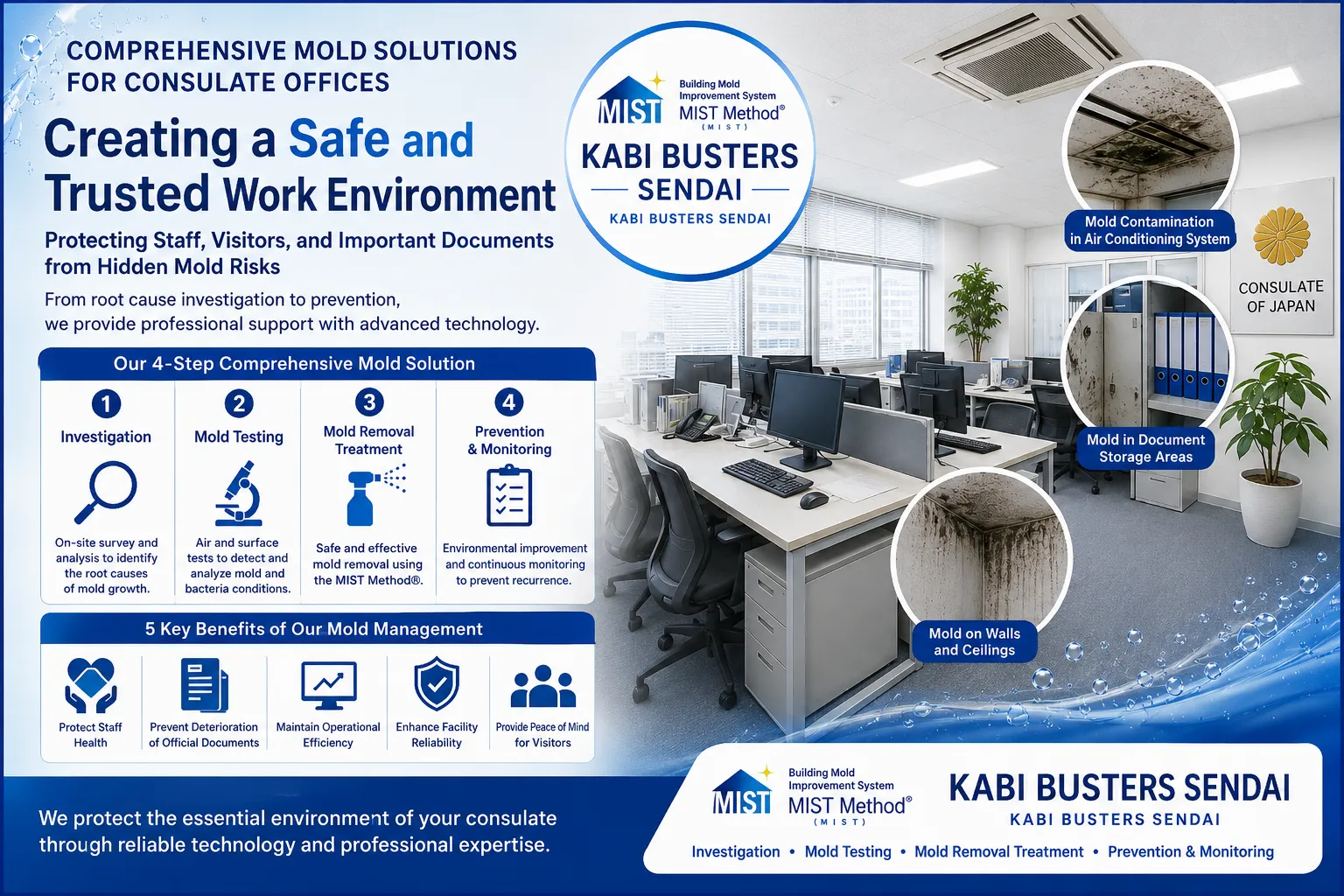
Comprehensive mold control measures for consulate offices by MIST Method® Mold Busters Sendai:
Specialized solutions that investigate not only visible mold but also its causes
—creating a safe work environment through cause investigation, fungal testing, mold removal, and recurrence prevention management.
Mold problems in consulate offices are often difficult to solve fundamentally with simple cleaning or temporary disinfection. This is because, although much of the mold found in offices appears as stains on the wallpaper or ceiling, it is often caused by a complex interplay of multiple factors, including condensation and moisture buildup inside the building, contamination of the air conditioning system, and insufficient ventilation.
Consulates are vital facilities that handle support for foreign residents, issue various certificates, and perform visa services, and they also provide a work environment where staff work long hours. Therefore, mold control measures must not only restore aesthetics, but also consider the protection of staff health, ensuring business continuity, preserving official documents, and maintaining the credibility of the consulate as an international organization.
At MIST Method® Mold Busters Sendai, we don't just look at the areas where mold has grown; we focus on the root cause of the mold growth and implement comprehensive countermeasures.
First and foremost, on-site investigation is crucial.
Many cases of mold found in offices are merely symptoms resulting from existing mold growth, and the real cause may lie elsewhere.
for example,
Condensation around air conditioning equipment
- Moisture buildup in the attic
Internal condensation inside the wall
- Water content due to leakage
• High humidity environment due to poor ventilation
- Stagnant air around the document storage area
And so on.
Simply removing the surface without understanding these underlying issues may lead to the same problem recurring.
Therefore, we first check the building's structure, usage, ventilation, and areas where condensation occurs to investigate the background of mold growth.
The next important step is bacterial testing.
Mold isn't just something you can see with your eyes.
In reality, a large number of spores may be floating in the air, and even if mold is not visible on the walls or ceiling, the air quality may be deteriorating.
In particular, in consular offices, where many staff and visitors share the same air environment, it is important to understand the state of mold spores in the air.
By conducting a bacterial test,
How much mold is present?
How far has the contamination spread?
Has the situation improved since the countermeasures were implemented?
This allows you to objectively verify things like that.
For facility managers, this also serves as important data for understanding environmental conditions that cannot be judged by visual inspection alone.
Afterward, mold removal treatment will be carried out as needed.
When it comes to mold prevention, the key is not simply removing dirt, but taking appropriate measures while considering the condition of the building materials and equipment.
Consulates have many facilities, including desks, storage facilities, document storage rooms, communication equipment, and air conditioning.
Therefore, it is important to proceed with the work while developing a construction plan that is tailored to each specific environment.
Furthermore, the mold problem is not resolved simply by completing the construction work.
What's more important is managing the prevention of recurrence after construction is complete.
The reason mold recurs in many facilities is that the damp environment and condensation-causing factors inside the building have not been addressed.
for example,
Review of humidity control
・Improvement of ventilation environment
• Regular maintenance of air conditioning equipment
- Inspection of areas where condensation occurs
- Improve air circulation around the document storage area
• Regular environmental checks
These are essential for preventing recurrence.
Because consulates handle important documents and confidential information, ensuring proper document storage environments is a crucial issue.
By controlling humidity levels inside the storage facility and conducting regular inspections, the risk of deterioration of official documents and the recurrence of mold can be reduced.
Furthermore, maintaining a good air environment in the office contributes to the health of the staff.
To prevent health problems such as coughs, rhinitis symptoms, headaches, and fatigue, it is important to continuously manage the risk of mold growth inside buildings.
Consulates are important facilities that support international exchange and administrative services.
Therefore, it is necessary to strike a balance between a work environment where staff can work with peace of mind and a facility environment that visitors can use with peace of mind.
At MIST Method® Mold Busters Sendai, we aim for comprehensive mold control, not just a temporary fix, by considering everything from cause investigation and fungal testing to mold removal measures and recurrence prevention management.
Rather than simply removing visible mold, understanding the risks lurking within the building and creating an environment that prevents mold from recurring is a crucial step in protecting the safe working environment of the consulate and its credibility as an international organization.
----------------------------------------------------------------------
カビバスターズ仙台
MPソリューション株式会社
〒980-0013
宮城県仙台市青葉区花京院2-1-61
オークツリー仙台1F
電話番号 090-8957-8975
----------------------------------------------------------------------