Serious Mold Damage Caused by Long-Term Vacancies in Public Accommodation Facilities in Yamagata Prefecture | Risks of Odor, Lifting Wallpaper, and Business Closure Due to Stopped Ventilation
2026/07/03
Serious Mold Damage Caused by Long-Term Vacancies in Public Accommodation Facilities in Yamagata Prefecture | Risks of Odor, Lifting Wallpaper, and Business Closure Due to Stopped Ventilation
A thorough explanation of secondary damage caused by condensation and high humidity unique to heavy snowfall areas | To protect the asset value and guest satisfaction of accommodation facilities
This is Inagaki from MIST Method® Mold Busters Sendai.
In recent years, there has been an increase in inquiries regarding mold damage during long periods of vacancy at public accommodation facilities, resorts, training facilities, and accommodation and training centers in Yamagata Prefecture. In particular, there has been a noticeable increase in cases where some rooms or floors are closed for extended periods due to fluctuations in the number of users, facility renovations, or operational reviews.
At first glance, it might seem that a room with little coming and going would be less dirty and less prone to problems. However, in reality, when ventilation equipment is turned off and windows are kept closed during periods of vacancy, moisture accumulates inside, creating an environment where invisible mold spores can rapidly proliferate.
Yamagata Prefecture has unique climatic conditions compared to the rest of Japan. In winter, heavy snowfall makes condensation common, and the accumulation of moisture around windows and inside walls due to the temperature difference between inside and outside becomes a major problem. In addition, in hot spring areas such as Zao, Tendo, and Kaminoyama, the high temperature and humidity environment affects the interior of facilities. Furthermore, in the Shonai region, the moisture load from the humid air and salty sea breezes from the Sea of Japan tends to accumulate in buildings.
In addition, older public accommodations often have insulation performance that does not meet current building standards, resulting in structures where condensation easily occurs inside walls and ceilings. Combined with the fact that ventilation is shut off at night and the chronic humidity unique to underground facilities, there have been numerous cases where mold contamination progresses inside guest rooms without the guests realizing it.
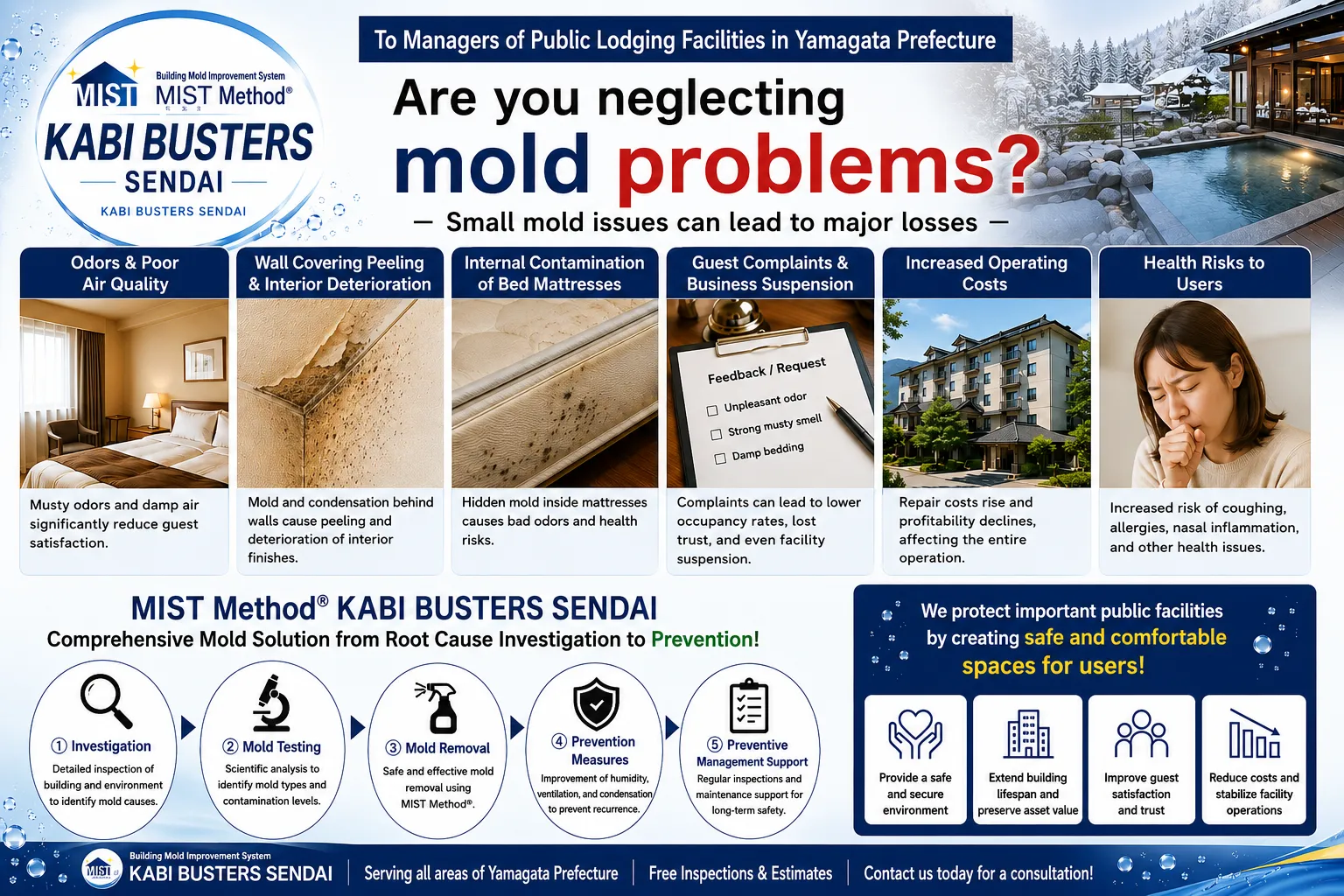
Mold that grows in these conditions is not merely a cosmetic problem. It can lead to a musty smell that permeates the guest rooms, complete peeling or lifting of wallpaper, serious contamination inside the mattresses, complaints from guests, and even significant economic losses due to business suspension or room closures.
This article will provide a detailed explanation of the characteristics of mold damage that commonly occurs in public accommodation facilities in Yamagata Prefecture, the regional environmental factors that underlie it, and the measures necessary to protect the asset value of the facilities and the satisfaction of the guests. We will introduce information that will be useful for facility managers, local government officials, and designated managers, so please read to the end.
目次
1. The increasing problem of mold in long-term vacant rooms at public accommodation facilities in Yamagata Prefecture.
The reality of mold contamination silently progressing in guest rooms that have been closed for extended periods.
— Don't assume it's safe just because there are no people around; stopping ventilation creates a dangerous indoor environment.
Yamagata Prefecture has many public accommodation facilities, including public lodging facilities, training facilities, recreation facilities, sports training camp facilities, and tourist exchange facilities operated by local governments. In recent years, it has not been uncommon for some rooms to remain vacant for extended periods due to fluctuations in the number of users, facility renovations, changes in designated managers, and seasonal operations.
However, among the consultations we receive from facility managers, the most common issues are: "When I opened a guest room after a long time, there was a strong musty smell," "The wallpaper was peeling," and "Mold had spread behind the beds and furniture."
Many people tend to think that rooms that are not frequently used will not get dirty and therefore will be less prone to problems. However, in reality, rooms that remain vacant for extended periods can actually become environments where mold is more likely to grow.
The main reason for this is the "cessation of ventilation."
In accommodations, doors and windows are typically opened and closed by guests coming and going, as well as during cleaning, allowing for natural ventilation. In addition, air conditioning and ventilation systems operate to expel moisture and pollutants from the room.
However, when a property remains vacant for an extended period, ventilation and air conditioning systems may be shut off as part of energy-saving measures and cost reduction efforts. Windows may also remain closed, resulting in very little air circulation inside the room.
When the air stops moving, the small amount of moisture present in the room gradually accumulates.
Yamagata Prefecture is known as a heavy snowfall area. In winter, the outside temperature drops significantly, and the temperature difference between inside and outside makes it easy for condensation to form on windowpanes and around window frames. If this condensation water does not dry completely and penetrates behind the wallpaper or around the window frame, it creates ideal conditions for mold to grow.
Furthermore, invisible mold spores are always present in the guest rooms.
Mold spores not only enter from outside, but are also routinely brought in by people's clothing and belongings, as well as airborne particles. Normally, ventilation and cleaning keep the concentration of mold down, but when ventilation is stopped, the mold remains indoors, and when combined with a high-humidity environment, it begins to multiply rapidly.
Furthermore, extra caution is needed when staying at public accommodations located in hot spring resorts.
In areas such as Zao Onsen, Kaminoyama Onsen, Tendo Onsen, and Akayu Onsen, the entire facility is susceptible to the effects of a high-humidity environment. Water vapor generated from baths and plumbing systems affects the interior of the building, and humidity tends to accumulate even in enclosed guest rooms.
In the Shonai region, humid air carried from the Sea of Japan affects buildings throughout the year. Facilities particularly affected by winter monsoon winds and sea fog tend to accumulate chronic moisture on walls and around windows, and mold damage often spreads during periods when ventilation is suspended.
Furthermore, insufficient insulation is a major problem in older public facilities.
In older buildings, temperature differences can easily occur inside the exterior walls and attics, leading to condensation in unseen areas. Even if no abnormalities are visible on the surface of the guest rooms, widespread mold contamination may already be progressing behind the wallpaper or in the attic.
If this condition persists for several months, half a year, or even more, a distinctive musty smell will begin to take hold in the guest rooms.
Odors are absorbed by building materials and fixtures such as wallpaper, curtains, mattresses, furniture, and tatami mats, making them impossible to remove with simple cleaning alone. Even if facility managers clean guest rooms before reopening, a lingering odor or heavy air may remain, sometimes leading to complaints from guests.
A further problem is that by the time visible mold appears, it's highly likely that mold contamination has already spread throughout the building.
In other words, small amounts of mold or odors in a guest room are not merely superficial problems, but can be a warning sign of ongoing humidity issues within the building.
Public accommodation facilities are important assets that support regional tourism promotion and exchange programs. Rather than assuming that long-term vacancies mean safety, properly managing ventilation and humidity during vacancy periods and detecting abnormalities early is a crucial initiative that leads to maintaining the asset value of the facility and improving user satisfaction.
2. The unique high-humidity environment of Yamagata Prefecture, created by heavy snowfall, hot springs, and sea breezes.
The humidity risk unique to Yamagata Prefecture, where climate and geographical conditions intertwine in a complex way.
— The invisible effects of heavy snowfall, hot springs, sea breezes, and topography on the interior of a building.
When considering mold problems in public accommodation facilities in Yamagata Prefecture, it is crucial to understand not only the aging of the buildings themselves and their management methods, but also the unique natural environment of the region. In fact, when conducting mold surveys and building inspections, even facilities with similar construction dates and structures can show significant differences in mold occurrence depending on the area in which they are located.
This is due to the unique climatic conditions and geographical environment of Yamagata Prefecture.
Yamagata Prefecture has significant climate differences within the prefecture, with each region having its own distinct characteristics, such as the Shonai region on the Sea of Japan side, the Murayama and Mogami regions in the inland area, and the Okitama region. However, what they all have in common is that humidity has a very significant impact on buildings in these areas.
The first major contributing factor is heavy snowfall.
Yamagata Prefecture is known as one of the heaviest snowfall areas in Japan. In winter, snow cover continues in many areas, and in mountainous regions, snow depths can exceed several meters.
Snow accumulation itself doesn't directly cause mold growth. However, a snow-covered environment contributes to maintaining high humidity levels around buildings for extended periods.
Furthermore, during winter, while the outside temperature drops drastically, the heating system inside the accommodation facility is running, resulting in a large temperature difference between the inside and outside of the building. This temperature difference makes condensation more likely to occur on windowpanes, sashes, inside the exterior walls, and in the ceiling space.
Condensation continuously supplies moisture to the interior of a building, creating a very favorable environment for mold growth.
Furthermore, the snow begins to melt in the spring.
Large amounts of snowmelt seep into the ground, increasing humidity around buildings. In public accommodation facilities with basements or semi-basements, moisture tends to accumulate under the floors and in the foundations, causing mold to grow in unseen places.
Another risk unique to Yamagata Prefecture is the presence of hot spring areas.
Yamagata Prefecture has many hot spring resorts, including Zao Onsen, Tendo Onsen, Kaminoyama Onsen, Akayu Onsen, and Onogawa Onsen. Public accommodations and resorts located in these areas are constantly exposed to high humidity environments.
Hot spring facilities are susceptible to the effects of water vapor generated from the baths and piping systems, which tends to increase the humidity inside the building.
In particular, during periods of low occupancy or in rooms that remain vacant for extended periods, insufficient ventilation combined with stagnant humidity can easily lead to mold growth behind wallpaper, on the backs of furniture, and inside closets.
Furthermore, the warm air unique to hot springs easily moves within the building, and condensation due to temperature differences is likely to occur, making humidity control throughout the entire facility crucial.
Furthermore, in the Shonai region, the influence of sea breezes from the Sea of Japan cannot be ignored.
In the areas surrounding Sakata City, Tsuruoka City, and Yuza Town, moist air flows in from the sea throughout the year. In particular, during winter, a large amount of moisture is blown onto the exterior walls of buildings by seasonal winds.
This moisture accumulates on the exterior walls and around window frames, causing condensation due to the temperature difference between these areas and the inside of the building.
Furthermore, sea breezes contain salt, which can accelerate the deterioration of metal components and equipment in buildings. When ventilation capacity decreases due to equipment deterioration, moisture tends to accumulate more easily, creating a vicious cycle that increases the risk of mold growth.
Another characteristic often seen in public accommodation facilities in Yamagata Prefecture is the presence of older buildings.
Many training facilities, resorts, and public accommodations built during the Showa era do not meet current insulation standards.
In buildings with insufficient insulation, temperature differences are likely to occur within walls, ceilings, and under floors. As a result, chronic condensation occurs in places unseen by the occupants, creating an environment where mold can grow over long periods.
Even in guest rooms that appear clean on the surface, it's not uncommon for mold to be growing behind the wallpaper or inside the plasterboard.
Furthermore, there are operational issues specific to public facilities.
During periods when there are no users, the ventilation system may be shut off at night to reduce energy costs. However, humidity continues to build up regardless of whether there are users or not.
Moisture stored within the building itself, as well as humidity entering from the outside air, will gradually accumulate inside the room if ventilation stops.
Facilities with underground machine rooms, underground guest rooms, or underground storage areas, in particular, tend to retain moisture, and prolonged periods without ventilation can lead to the rapid spread of mold.
Thus, public accommodation facilities in Yamagata Prefecture are in an environment where multiple factors tend to combine, such as "condensation due to heavy snowfall," "high humidity in hot spring areas," "sea breezes and salt damage humidity unique to the Sea of Japan side," "insufficient insulation in older buildings," "operation with ventilation disabled," and "chronic humidity in underground facilities."
Mold does not arise from a single cause. Understanding the effects of humidity due to regional characteristics and managing the risks associated with each building is a crucial step in maintaining the safety and longevity of public accommodation facilities, as well as improving user satisfaction.
3. Deterioration of guest room odors and air quality due to cessation of ventilation.
Deterioration of air quality in accommodations goes beyond just a musty smell.
— The "unpleasant smell" that guests first notice greatly influences their evaluation of the facility.
The first impression guests have of accommodation isn't just the building's exterior or the front desk service. The quality of the air and the smell they perceive the moment they open their room door are crucial factors that significantly impact guest satisfaction.
In particular, in public accommodation facilities in Yamagata Prefecture, some rooms may be closed for extended periods due to long-term vacancies, seasonal operation, or fluctuations in usage frequency. If ventilation equipment is shut down during this time, the air quality inside the rooms deteriorates unseen, which can lead to more serious secondary damage than facility managers might imagine.
In many cases, the first abnormality to appear is a "bad smell."
The distinctive musty or damp smell and heavy atmosphere you notice when opening a guest room after a long time are typical symptoms that cause discomfort to guests. However, this odor is not just an unpleasant smell; it is also a warning sign of dampness problems and mold contamination progressing inside the building.
Mold releases volatile organic compounds during its growth process.
These components accumulate in the indoor air, resulting in what is commonly known as a musty smell. In facilities with proper ventilation, the concentration is reduced by air exchange, but when ventilation is stopped, they remain in the room, causing the odor to gradually intensify.
In Yamagata Prefecture, conditions are ripe for moisture to accumulate inside buildings due to condensation caused by heavy snowfall in winter, increased humidity due to snowmelt in early spring, and the high humidity environment unique to hot spring areas.
As a result, mold often grows behind wallpaper, in the ceiling, on the back of furniture, and inside closets, causing odors to spread throughout the entire room.
The problem is particularly when the source of the odor is not visible on the surface.
Even if a guest room is cleaned and made to look presentable, odors will persist if mold remains inside the walls or ceiling. Even if the management deems the room "clean on the surface," guests may notice something is off immediately upon entering.
Guests are unaware of the building's structure or how mold grows.
Therefore, people sometimes judge an entire facility based solely on subjective feelings such as "it smells a bit," "the air feels heavy," or "it feels damp."
In recent years, online booking sites and review sites have become extremely influential.
"The room smelled musty."
"The air was stuffy."
"The bedding was damp."
"I felt the cleaning was insufficient."
When such reviews are posted, it can damage the overall image of the facility, even if the problem is actually not cleaning but rather dampness or mold inside the building.
Public accommodation facilities, in particular, are frequently used not only by tourists but also by groups such as those participating in sports competitions, training sessions, school trips, and local government events. Therefore, if a negative impression spreads, it could directly lead to a decline in occupancy rates.
Furthermore, odor problems can lead to health concerns for guests.
When the mold itself or its spores dispersed in the air increase, some people may experience symptoms such as rhinitis, cough, throat discomfort, and eye irritation.
Of course, the way symptoms manifest varies from person to person, but for young children, the elderly, and those with allergies, poor air quality can detract from the entire lodging experience.
Furthermore, odors are absorbed by various materials in the room.
Wallpaper, curtains, mattresses, futons, sofas, tatami mats, and wooden furniture easily absorb odors, and once an odor has set in, it is not easy to remove.
Once the problem can be resolved through ventilation alone, more extensive measures such as replacing wallpaper, changing bedding, or updating furniture may become necessary.
This places a significant burden on the operation of the facility.
Furthermore, if odor problems are left unaddressed for an extended period, they cease to be merely a problem on a room-by-room basis.
Odor components and spores can spread through air conditioning systems and common corridors, potentially affecting adjacent guest rooms and common areas.
It's not uncommon for a problem that started in just one room to spread to the entire floor, or even the entire facility, before anyone realizes it.
In particular, public accommodation facilities located in hot spring areas and heavy snowfall regions within Yamagata Prefecture tend to have a rapid progression of odors once they start to develop because the entire building is susceptible to the effects of a high-humidity environment.
To prevent these problems, it's crucial to identify the source of the odor itself, rather than simply taking measures to eliminate it.
It is necessary to investigate where moisture is being generated, where mold is growing, and whether condensation is occurring inside the building during the period when ventilation is stopped, in order to identify the root cause and then take countermeasures.
In accommodation facilities, air quality is an invisible quality in itself. To maintain an environment where guests can stay comfortably, it is essential to manage the air quality, including odors and humidity, in addition to visual cleanliness. Room odors caused by halted ventilation are not merely an unpleasant experience, but must be viewed as a critical management issue that affects guest satisfaction, facility evaluation, and even operating revenue.
4. Building damage that progresses to complete peeling of wallpaper and deterioration of interior finishes.
Lifting wallpaper is a warning sign of deterioration inside the building.
— Invisible condensation and mold contamination within walls are eroding the lifespan of public accommodation facilities.
When people think of mold problems in public accommodations, they often picture "smells" or "black stains on the walls." However, these are actually just the beginning of the problem. What's truly serious is the impact on structural materials caused by condensation and mold that progresses inside the building.
In particular, in public accommodation facilities in Yamagata Prefecture, condensation occurring inside walls is a major problem due to the harsh climatic conditions and high humidity environment unique to heavy snowfall regions.
Common inquiries from users include:
"The wallpaper is peeling off."
"The seams of the wallpaper are open."
"There are wrinkles in the wallpaper."
"It's come loose again, even though it was replaced before."
These are the symptoms.
These may not simply be signs of age-related deterioration, but rather signs of moisture and mold growing inside the wall.
Wallpaper is an interior finishing material used to cover the surface of a building, but behind it are materials such as gypsum board, underlayment, and insulation.
Normally, it remains dry, but the situation changes drastically if condensation or moisture intrusion occurs.
When moisture accumulates inside the wall, the adhesive holding the wallpaper in place gradually deteriorates.
Initially, slight lifting occurs at the edges and seams of the wallpaper, and then, as the area expands, wrinkles and lifting appear across the entire wall.
In Yamagata Prefecture, there are certain environments where this phenomenon is particularly likely to occur, such as in public accommodation facilities.
Outside temperatures drop significantly during the winter months.
On the other hand, the temperature inside the facility is maintained by heating.
This temperature difference causes condensation to form inside the exterior wall.
Older public facilities, in particular, may not have the same level of insulation as current building codes, resulting in structures where condensation is likely to occur inside walls and ceilings.
Even if there are no visible abnormalities on the wall surface to the user, there are many cases where moisture is constantly being supplied behind the wallpaper.
Furthermore, if the ventilation system is shut down during a long period of vacancy, moisture inside the building will not be able to be removed.
Condensation that forms inside the wall remains without drying, creating an environment where mold can grow.
Mold thrives in damp places.
In particular, areas behind wallpaper, on the surface of plasterboard, and on wooden substrates contain organic matter that serves as a nutrient source, so once moisture is supplied, they can rapidly multiply.
The problem is that this mold progresses in places that are not visible.
By the time symptoms appear on the surface of the wallpaper, widespread contamination may have already occurred inside.
Among facility managers,
"You only need to replace the loose wallpaper."
Some people think that way.
However, simply replacing the wallpaper while the underlying condensation or mold remains may result in the same areas lifting or peeling again.
When we actually conduct mold investigations, it's not uncommon to find cases where the mold has reappeared just a few months after replacement.
Even more serious is the fact that moisture can affect the structural materials of a building.
If the wood and underlayment inside the wall remain damp for an extended period, the risk of decay fungi developing increases.
Wood-rotting fungi break down wood, causing it to lose strength.
Even if there are no visible changes in the initial stages, wood deterioration progresses over time, which can affect the durability of the building.
Public accommodation facilities are larger in scale and have a larger number of users compared to private residences, so when major renovations are needed, significant costs are incurred.
If the problem can be solved simply by replacing the wallpaper, it will be a relatively minor repair. However, if the repair involves replacing the drywall, repairing the substrate, replacing the insulation, or repairing the woodwork, the scope of work will expand considerably.
Furthermore, in the case of accommodation facilities, it may be necessary to suspend the use of guest rooms during the construction period.
In other words, it's not just repair costs that are incurred, but also lost business opportunities.
In facilities located in the hot spring areas of Yamagata Prefecture, the effects of humidity generated from bathing equipment and piping are also a factor.
Furthermore, in the Shonai region, humid air from the sea continues to have an impact on buildings.
In facilities with underground guest rooms or semi-underground structures, the risk of condensation inside the walls is further increased due to moisture from the ground.
In these conditions, lifting or peeling of wallpaper is not simply a matter of interior finishing defects.
It is an important warning sign that indicates the beginning of moisture problems, mold contamination, and even deterioration of structural materials within the building.
Public accommodation facilities are both a local tourism resource and an important public asset. To ensure the long-term safe use of these buildings, it is crucial not only to perform superficial repairs but also to properly investigate what is happening inside the walls and address the root causes of the problems.
Understanding that loose wallpaper is not just an aesthetic issue but a crucial message related to the very lifespan of the facility, and taking early action, will help maintain asset value and reduce the cost of major repairs.
5. Contamination of bed mattresses and health risks to guests
The horror of mold contamination progressing unseen inside your bedding.
— Bed mattress contamination and health risks threaten hygiene management in guest rooms
When people think of mold problems in public accommodations, they often picture black mold on walls, ceilings, and around windows. However, actual on-site investigations sometimes reveal an even more serious problem: mold contamination inside the mattress.
In particular, in public accommodation facilities in Yamagata Prefecture, the combination of long-term vacancies, lack of ventilation, and high humidity conditions often leads to mold contamination progressing inside bedding, which is not visible to guests.
When facility managers inspect guest rooms, the inspections usually focus on tasks such as changing sheets, cleaning surfaces, and vacuuming.
Of course, these tasks are very important for hygiene management. However, they often fail to detect mold contamination occurring inside the mattress.
When we actually conduct a mold survey,
Mold is growing under the bed.
Black mold is growing on the back of the mat.
The wooden bed frame is moldy.
A strong odor is emanating from inside the mat.
This situation can sometimes be observed.
This is by no means an unusual case.
Accommodation facilities in Yamagata Prefecture are susceptible to the effects of condensation and high humidity, which are characteristic of heavy snowfall areas, and conditions are such that moisture tends to accumulate around the beds in guest rooms.
In particular, in rooms that have not been used for a long period of time, airflow is reduced, and moisture cannot escape from areas where air stagnates, such as under the bed and along the walls.
Furthermore, due to its structure, a mattress has many air pockets.
The interior is made of materials such as urethane, cotton, and fiber, and once it absorbs moisture, it has the characteristic of being difficult to dry.
If ventilation is insufficient for an extended period, the moisture that accumulates inside the mat will create an environment where mold can thrive.
Particular caution is needed when no abnormalities are visible on the surface.
Even if the sheets are removed, the room may still look clean on the outside. However, mold spores may be proliferating inside, causing odors and producing spores.
The piece of furniture that guests spend the most time in their room is the bed.
During sleep, your face is close to the mattress and pillow, creating an environment where you are more likely to inhale mold spores floating in the air.
the result,
I cough while I'm sleeping.
I wake up with a stuffy nose.
My throat feels scratchy.
My eyes get itchy.
The air feels heavy.
This can lead to feelings of discomfort.
Of course, not all symptoms are caused solely by mold, but if the air quality around bedding deteriorates, it will undoubtedly have a significant impact on the user's comfort.
Elderly people, young children, those with allergies, and those with respiratory illnesses require extra caution.
Public accommodation facilities serve a variety of users, including not only tourists but also sports teams, school groups, local government training programs, and senior citizen groups.
Therefore, maintaining hygiene in bedding is one of the important responsibilities in facility management.
However, mold inside the mattress cannot be removed by normal cleaning.
While wiping the surface or vacuuming can improve the appearance, it won't fundamentally solve the problem of mold and odors that have penetrated the interior.
Furthermore, even if you use commercially available disinfectant sprays, it is often difficult for them to penetrate deeply enough, and the cause of the problem remains.
Furthermore, mattresses that have mold growing on them will accumulate odors.
This odor can transfer to sheets, blankets, and pillows, leading to a deterioration of the overall air quality in the guest room.
The moment a user enters their room,
"It smells a bit strange."
"Damp"
"The bedding looks old."
That's the impression I sometimes get.
In reality, in many cases, the odor is not due to the bedding being worn out, but rather to internal contamination.
In recent years, ratings on review sites and accommodation booking sites have had a significant impact on the operation of facilities.
"The bed smelled bad."
"The bedding was damp."
"I couldn't sleep comfortably."
Such reviews also influence whether new users decide to make a reservation.
In public accommodation facilities, bedding management should be considered not merely a cleaning task, but a management issue, as it can impact local tourism and exchange programs.
Furthermore, neglected contamination of the mattress can lead to the spread of mold throughout the entire guest room.
Mold that grows inside the mat continues to release spores, which can spread to surrounding wallpaper, curtains, and furniture.
What starts as a problem with the bedding can eventually escalate into a deterioration of the air quality throughout the entire guest room.
That's why it's important not to judge solely on what's visible.
Mold contamination inside mattresses cannot be resolved by surface cleaning alone. Proper inspections, odor surveys, and mold tests are necessary before reopening rooms after long periods of vacancy to check the condition of the bedding inside, which is essential to protect the health of guests and ensure a comfortable stay.
The reliability of public accommodation facilities is maintained only when a safe and secure environment is ensured for guests to sleep soundly. Paying attention to mold contamination inside bedding, which is often unseen, is a crucial initiative that contributes to maintaining the value of the facility and improving guest satisfaction.
6. Business risks that can escalate to accommodation complaints, business suspension, and operating losses.
A slight odor can become a serious problem that threatens the management of a facility.
— The mechanism by which neglecting mold damage leads to guest complaints, room closures, and decreased profitability
In public accommodation facilities, mold problems are not merely a building management issue. In reality, they represent a significant business risk that impacts the facility's reputation, occupancy rate, revenue, and even its operation itself.
However, at the scene,
"It only smells a little."
"There's just a small stain on the wallpaper."
"It's a vacant room, so there's no problem right now."
This may lead to the situation being judged as such, and the response being postponed.
However, a characteristic of mold damage is that the longer it is left untreated, the more the damage spreads, eventually resulting in significant losses.
In particular, public accommodation facilities in Yamagata Prefecture face a combination of conditions that make them prone to mold growth, including condensation due to heavy snowfall, high humidity in hot spring areas, humid air from the Sea of Japan side, and existing facilities with insufficient insulation.
Therefore, once mold appears, it is difficult for it to improve naturally, and the damage tends to spread over time.
The first business problem that arises is accommodation complaints.
Guests are not experts.
We are unaware that condensation is occurring inside the walls of the guest rooms, nor that mold is growing in the ceiling space.
What users feel is,
"The room smells bad."
"The air feels heavy."
"Damp"
"The bedding was uncomfortable."
That's the experience itself.
And that impression is remembered as part of the overall evaluation of the accommodation.
In recent years, online booking sites and review sites have become important factors in choosing accommodations.
Even just one review,
"I was bothered by the musty smell."
"The room was damp."
"I wasn't able to spend my time comfortably."
If such information is published, it will have a significant impact on users who are considering making a reservation.
Unlike private hotels, public accommodation facilities also play a role in promoting local tourism, accommodating sports training camps, and providing training facilities.
Therefore, a decline in facility ratings could not only lead to a decrease in sales but also to a loss of usage opportunities for the entire community.
Furthermore, an increase in complaints will overwhelm facility operators with the task of handling each case individually.
This will result in issues such as refunds, room changes, apologies, and additional cleaning, which will impact our regular operations.
This can increase the burden on staff, creating a vicious cycle that can ultimately lead to a decline in overall service quality.
If the mold problem progresses, the next step may be to close the guest rooms.
for example,
The entire cross is lifted.
Contamination of ceiling materials
Bedding contamination
Strong odor
Mold growth inside the wall
When conditions like these arise, it becomes difficult to continue using the accommodation service.
There are cases where the facility determines that it is not in a condition to provide services to users and is forced to temporarily suspend its use.
This is where operational losses occur.
In accommodation facilities, guest rooms are a crucial asset that generates revenue.
If even one room becomes unavailable, the accommodation revenue that would have been generated from that room is lost.
Furthermore, if the damage spreads to multiple rooms, the amount of loss will increase significantly.
For example, during peak seasons, such as when there are group bookings or when rooms need to be closed due to tourist season, there may be situations where we have to turn away guests who we could have otherwise accommodated.
This can result in losses far greater than the visible repair costs.
Furthermore, mold damage is also progressing inside the building.
Once the problem has gone beyond the stage where simply replacing the wallpaper is sufficient,
Drywall replacement
Insulation replacement
Wood repair
Complete interior renovation
Bedding change
Furniture exchange
Large-scale repairs like the ones mentioned above may be necessary.
Problems that initially could be addressed for tens or hundreds of thousands of yen can sometimes escalate into renovation projects costing several million yen.
Furthermore, public facilities require budgeting and procurement procedures, which can sometimes take time to address.
During this time, the damage continues to progress, which is why the problem tends to become protracted.
Accommodation facilities located in hot spring areas within Yamagata Prefecture are susceptible to the effects of humidity generated from the baths and plumbing systems.
In addition, in the Shonai region, the humidity caused by sea breezes, and in heavy snowfall areas, repeated condensation, affect buildings.
In other words, if the root cause of the mold problem remains, there is a possibility that it will recur even after repairs are made.
This risk of recurrence poses a significant burden on facility management.
Repeatedly repairing the same areas increases maintenance costs and erodes user trust.
As a result,
Facility rating decline
Decrease in utilization rate
Poor customer reviews
Revenue decline
Increased renovation costs
Room Closure
This creates a chain reaction.
This is precisely why a small mold problem can escalate into a major business risk.
Public accommodation facilities are important public assets used by many people, including local residents, tourists, and trainees. To maintain their value, it is important not to overlook early abnormalities such as odors, dampness, and condensation, in addition to visible mold, and to investigate the cause and take countermeasures as soon as possible.
Addressing mold problems is not simply a matter of building management. It is a crucial management decision that protects the reliability of the facility, user satisfaction, profitability, and the future continuity of operations.
7. Comprehensive mold control measures for public accommodation facilities using the MIST Method® by Mold Busters Sendai.
We thoroughly investigate not only the visible mold damage but also its underlying causes.
— Comprehensive mold control to protect the asset value and user satisfaction of public accommodation facilities
Mold problems in public accommodations cannot be solved simply by removing visible mold. Issues such as odors in guest rooms, peeling wallpaper, contamination inside mattresses, and guest complaints are all symptoms that appear as a result of humidity, condensation, and poor ventilation occurring inside the building.
Therefore, what's truly important is to clearly identify "why mold has grown" and take appropriate measures to address the cause.
At MIST Method® Mold Busters Sendai, we don't view mold problems in public accommodation facilities as simply a matter of cleaning or superficial removal.
We aim to maintain the safety and asset value of the facility by comprehensively investigating the building's condition, identifying the cause, performing mold removal, and implementing measures to prevent recurrence.
In public accommodation facilities in Yamagata Prefecture,
Condensation due to heavy snowfall
High humidity characteristic of hot spring areas
Humidity caused by sea breezes in the Shonai region
Condensation inside walls due to insufficient insulation
Chronic dampness in underground facilities
Ventilation stopped during long-term vacancies
In many cases, mold damage occurs due to a combination of multiple factors, such as those mentioned above.
In environments like this, simply removing the mold that is visible on the surface will not provide a fundamental solution.
For example, even if mold has grown on the wallpaper in a guest room, if the cause is condensation inside the wall, the mold may grow again as long as the cause remains.
Furthermore, even if the odor is temporarily suppressed with a deodorizer, if mold remains inside the building materials or mattress, the odor will reappear over time.
That's why the first thing you need to do is investigate the cause.
The on-site inspection comprehensively checks the building's structure, location, ventilation, condensation locations, past water leakage history, and guest room usage.
In the case of public accommodation facilities, there are often long periods when the rooms are unoccupied, so the management and ventilation operations during vacancy periods are also important survey items.
The next important step is bacterial testing.
Mold exists not only on visible surfaces but also in the air.
Therefore, judging solely by the surface condition may not accurately reflect the actual extent of contamination.
By conducting a bacterial test,
To what extent is mold contamination occurring?
What is the state of the air environment?
Is mold spore spreading within the facility?
This allows us to objectively confirm situations like these.
In particular, checking the air quality is extremely important in public accommodation facilities, as it is a space where guests stay overnight.
After the cause is identified through investigation and testing, mold removal treatment will be carried out according to the situation.
What's important here is not just looking at the areas where mold has been found, but understanding the entire extent of the contamination.
By comprehensively addressing areas such as visible mold in the guest rooms, areas where odors are occurring, and places where condensation is happening, we aim to reduce the risk of recurrence.
Furthermore, in public accommodation facilities, the safety of guests and consideration for the building itself are also important.
Therefore, it is necessary to formulate an appropriate construction plan that is tailored to the facility's conditions and to implement measures while minimizing the impact on operations as much as possible.
Even more important are measures to prevent recurrence.
In reality, preventing recurrence may be more important than simply removing the mold.
Public accommodation facilities in Yamagata Prefecture will continue to face the region's unique climatic conditions.
The condensation caused by heavy snowfall, the humidity in hot spring areas, and the moist air from the Sea of Japan side will not disappear.
That's why preventative management tailored to the specific characteristics of each building is necessary.
for example,
Ventilation management during vacancy periods
Review of humidity control
Regular inspections
Checking the location of condensation
Odor check before reopening of guest rooms
Moisture control measures for underground facilities
By continuously implementing measures such as these, we can prevent the recurrence of the damage.
Public accommodation facilities are important facilities that support local tourism promotion and exchange programs.
Once a mold problem occurs, it can lead to many losses, including guest complaints, a decline in facility ratings, room closures, and increased repair costs.
However, by identifying the cause early and implementing appropriate countermeasures and preventive management, it is possible to significantly reduce the risk.
At MIST Method® Mold Busters Sendai, we provide comprehensive support, from cause investigation and fungal testing to mold removal and recurrence prevention measures, going beyond simple mold removal. We will continue to emphasize the importance of comprehensive management, including invisible mold risks, in order to create an environment where users of public accommodation facilities can stay with peace of mind and to maintain the asset value of the facilities.
----------------------------------------------------------------------
カビバスターズ仙台
MPソリューション株式会社
〒980-0013
宮城県仙台市青葉区花京院2-1-61
オークツリー仙台1F
電話番号 090-8957-8975
----------------------------------------------------------------------