[Yamagata and Miyagi Prefectures] Mold problem in vacant public facilities is becoming serious | Widespread mold contamination and risk of difficulty in reuse are progressing in closed facilities
2026/07/02
[Yamagata and Miyagi Prefectures] Mold problem in vacant public facilities is becoming serious | Widespread mold contamination and risk of difficulty in reuse are progressing in closed facilities
The invisible crisis caused by the cessation of ventilation: Mold, decay, and foul odor damage progressing in vacant public facilities and the importance of early countermeasures.
This is Inagaki from MIST Method® Mold Busters Sendai.
In recent years, due to nationwide population decline and the effects of facility consolidation, many public facilities such as schools, community centers, meeting halls, welfare facilities, and accommodation and training facilities have been closed and unused. In particular, in the Tohoku region, the number of public facilities with declining usage is increasing due to the declining birthrate, aging population, and regional restructuring, making maintenance and management a major challenge.
When a facility is closed, not only does the flow of people cease, but ventilation systems and air conditioning equipment are often shut down. Sometimes ventilation is stopped for reasons such as "we want to save on electricity costs because no one is using it" or "we want to reduce management costs," but in reality, this decision creates a very significant risk to the building.
Even when buildings are not in use, they continue to be affected by outside temperature and humidity. The Tohoku region, in particular, is prone to moisture buildup inside buildings due to condensation in winter, snowmelt in early spring, high humidity during the rainy season, and rising temperatures in summer. In enclosed facilities, airflow is lost, causing moisture to accumulate in the walls, attics, under floors, and inside storage areas, creating conditions for rapid mold growth.
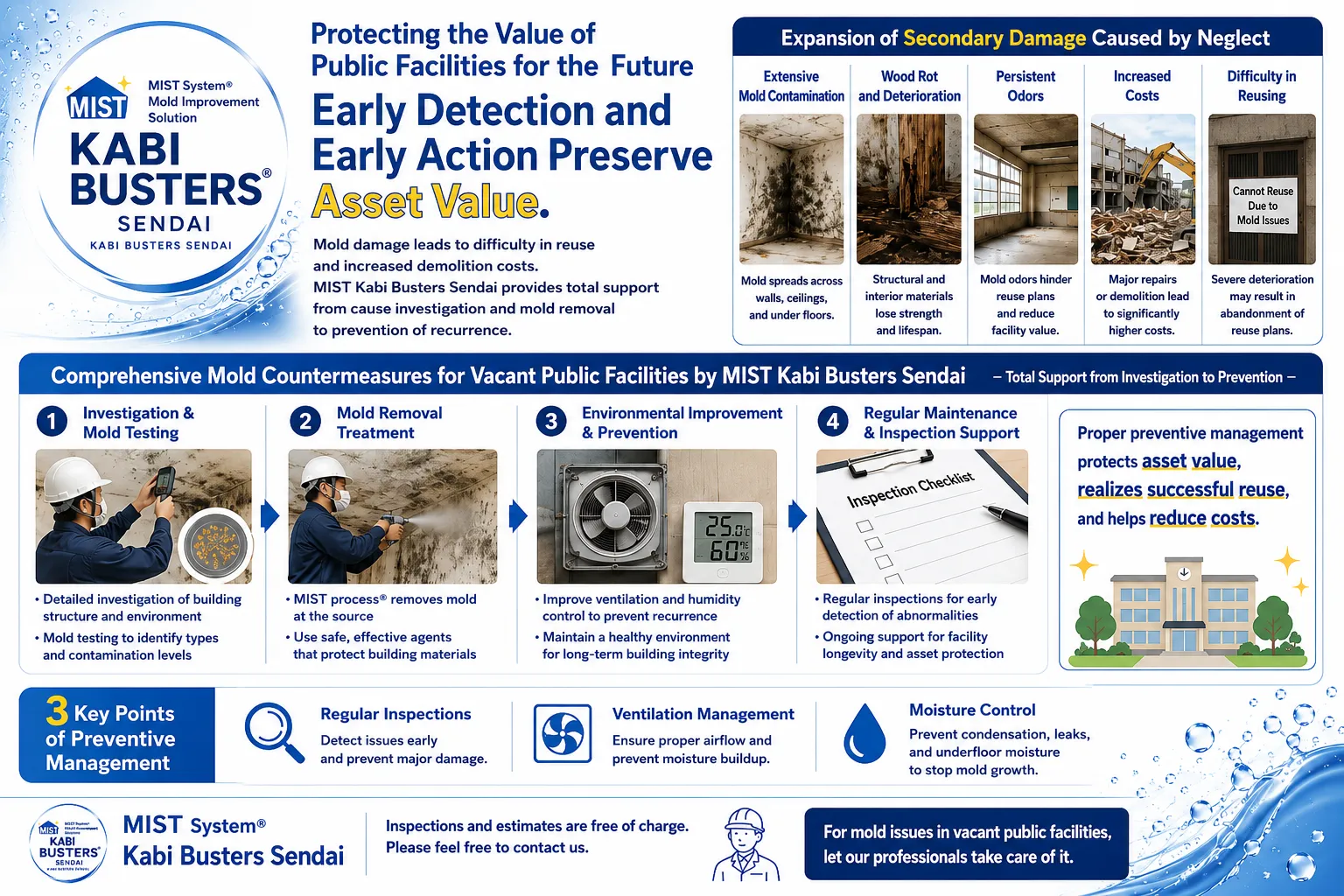
Furthermore, if mold growth is left untreated, it's not just a cosmetic problem. It can lead to numerous secondary damages, including the spread of mold contamination throughout the entire facility, wood decay, deterioration of equipment, the establishment of strong odors, and even the cancellation of reuse plans or the need for large-scale renovation work. In fact, it's not uncommon for cases to arise where "a complete renovation became necessary after being left untreated for just a few years" or "a facility that was planned for reuse became unusable."
Public facilities are valuable assets to the community. Even when considering future reuse, sale, or change of use, it is crucial to maintain the building in good condition. To achieve this, regular inspections, humidity control, and mold prevention measures are essential, even when the facility is closed, to address problems before they escalate.
This article will explain in detail why mold problems occur in vacant public facilities, the dangerous secondary damage caused by ventilation failures, the impact on building asset value, and the professional investigation, mold removal, and recurrence prevention measures carried out by MIST Method® Mold Busters Sendai. We hope this will be helpful for those considering maintenance, management, or reuse plans for vacant facilities.
目次
The surge in mold problems in vacant public facilities
Invisible deterioration begins after use ceases – the mechanism of moisture accumulation and mold growth that progresses in buildings that are no longer inhabited.
One of the main reasons for the surge in mold problems in vacant public facilities is the accumulation of moisture and cessation of ventilation that occurs after the facilities are closed. Many people tend to think that "since no one is using it, the building won't deteriorate," but in reality, the opposite is true; buildings that no longer have people coming and going can become environments where mold is more likely to grow.
Public facilities such as schools, community centers, meeting halls, health centers, welfare facilities, and training facilities normally have their doors and windows opened and closed by people coming and going, and their air conditioning and ventilation systems are also running. As a result, the air inside the building circulates and humidity is kept low. However, the situation changes drastically when the facility is closed.
In order to reduce maintenance costs, air conditioning and ventilation systems are often shut down, causing indoor air to become almost stagnant. When air stagnates, condensation is more likely to occur due to the temperature difference with the outside air, and moisture gradually accumulates inside the building. In particular, the Tohoku region has many factors that generate moisture throughout the year, such as temperature fluctuations in winter, snowmelt in early spring, high humidity during the rainy season, and high temperatures and humidity in summer.
Even when buildings are not in use, they are constantly affected by the external environment. There are many sources of moisture, including rainwater intrusion, moisture rising from the foundation, heat from the exterior walls and roof, and water vapor from the basement. Moisture that should be expelled through ventilation remains inside the building, creating an ideal environment for mold growth.
Areas that are difficult to keep an eye on require particular attention. Attics, crawl spaces, machine rooms, warehouses, storage spaces, inside walls, backstage areas, and backyards are prone to moisture buildup, and inspections tend to be less frequent after closing. As a result, mold can spread over a wide area unnoticed, and in many cases, by the time it is discovered, the entire building may have been affected.
Furthermore, public facilities often use many building materials that serve as nutrients for mold, such as wood, gypsum board, wallpaper, insulation, tatami mats, and carpets. When moisture accumulates, mold begins to grow on the surfaces and inside these materials. In the initial stages, it appears as small black dots or white powdery mold, but as it is left untreated for a long time, it will spread to the entire wall or ceiling surface.
Furthermore, cleaning frequency decreases in enclosed facilities. Anomalies that would normally be detected during cleaning are more likely to be overlooked, and the accumulation of dust and organic matter further promotes mold growth. Since dust is an important nutrient source for mold, the combination of lack of ventilation and insufficient cleaning accelerates the rate at which damage spreads.
In recent years, there has been a nationwide increase in cases of school closures due to mergers and consolidations, as well as the temporary closure of public facilities due to declining usage. Even facilities that are planned for reuse, sale, or private use will deteriorate rapidly if they are not properly maintained. In some cases, noticeable mold may appear within a few months, while in others, after being left unattended for several years, mold can spread throughout the entire building, requiring extensive renovations.
A particular problem is that the extent of the damage cannot be judged solely from the exterior. Even in buildings that appear fine at first glance, large amounts of mold may be growing in the attic, inside the walls, or under the floor. If the building is put back into use in that condition, facility users may smell mold or inhale mold spores that have become airborne.
Public facilities are valuable assets for local residents. If we are looking ahead to their future use, it is important to conduct regular inspections and humidity control even when they are closed, and to detect signs of mold at an early stage. Mold problems tend to spread over time, and repair costs also tend to increase. That is why, when managing vacant public facilities, the mindset should not be "it's okay because it's not being used," but rather "management is necessary precisely because it's not being used."
The reality of widespread mold contamination caused by ventilation failure
Mold contamination silently spreads throughout the entire building – the reality of serious secondary damage starting in unseen places.
When public facilities are closed and ventilation systems remain shut down for extended periods, mold contamination inside buildings progresses at an unexpectedly rapid pace. Many facility managers assume that there's only a small amount of mold on the walls, but upon inspection, they often find that the mold has actually spread extensively to the ceilings, under the floors, and even inside storage areas. The frightening thing about mold is that it doesn't stay confined to the area where it originates, but spreads throughout the entire building.
Mold thrives in places with moisture and nutrients, and as it grows, it releases spores. These spores are very small and can gradually spread throughout a building, even in enclosed facilities with little airflow. In enclosed public facilities, regular ventilation is not performed, so the released spores remain stagnant indoors, creating new breeding grounds one after another.
The walls are often the first place to be affected. Condensation is especially likely to occur on north-facing walls and areas adjacent to exterior walls due to temperature differences. When wallpaper or drywall absorbs moisture due to condensation, mold begins to grow not only on the surface but also inside. Even if you wipe away the mold on the surface, it will reappear if the fungus remains inside, so this is not a fundamental solution.
The ceiling is also a very dangerous area. Temperature changes transmitted from the roof, small leaks, and reduced insulation can easily cause moisture to accumulate in the ceiling space. In particular, in closed schools and community centers, opening the ceiling inspection hatch can reveal widespread mold growth. Because the ceiling space is not normally visible, problems are often discovered late, and the damage tends to become severe.
Even more serious is the area under the floor. The area under the floor is inherently prone to high humidity, and if ventilation is insufficient, the moisture has nowhere to escape. Combined with moisture from the ground and rainwater, the wood remains damp for extended periods, accelerating mold growth. Mold under the floor can affect the air quality throughout the entire building, and spores can even enter the room through gaps in the flooring or around pipes.
Storage areas and warehouses are also places where damage can easily spread. Public facilities have many storage spaces such as equipment rooms, textbook storage rooms, document storage rooms, and locker rooms. These spaces have poor airflow and are prone to moisture buildup. If left unattended for a long period after closing, mold can grow on shelves, stored items, walls, and ceilings, and the stored items themselves may become unusable.
Furthermore, mold doesn't only grow in visible areas. It also proliferates inside the building structure, such as in the insulation inside the walls, the wood in the ceiling, and the joists and beams under the floor. These areas are difficult to check during normal inspections, and by the time symptoms appear on the surface, extensive contamination may already be progressing inside.
In the case of public facilities, a key characteristic is that the problem is not limited to just one room. Spores can travel through corridors, stairwells, air conditioning ducts, and piping spaces, spreading the infection throughout the entire facility. In large facilities in particular, it is not uncommon for contamination to spread to multiple floors over a period of several months to several years.
Furthermore, if mold contamination progresses throughout the entire facility, it will not only cause discoloration and stains on building materials, but also leave a distinctive musty odor that permeates the entire building. This odor easily adheres to wallpaper, wood, carpets, etc., and is difficult to remove with normal cleaning. When considering reuse, problems such as "the entire facility smells musty" and "users are complaining" may arise, which can affect the utilization plan itself.
In recent years, there has been a growing trend to reuse closed school facilities and public facilities after school mergers and closures as community exchange facilities or private business facilities. However, in buildings that have been left neglected for a long time, pre-reuse inspections sometimes reveal extensive mold contamination, resulting in costs far exceeding the planned renovation budget. Surface cleaning alone is often insufficient, and it is frequently necessary to remove or replace building materials.
Mold contamination due to cessation of ventilation is not just a problem in a few rooms. It can spread to walls, ceilings, under floors, inside storage areas, and even into the building's structure, gradually reducing the asset value of the entire facility without you even noticing. That's why it's crucial to conduct regular inspections and humidity control even in closed public facilities, and to prevent further damage through early detection and response. MIST Method® Mold Busters Sendai conducts inspections that include areas that cannot be seen with the naked eye, assesses the mold risk of the entire facility, and proposes appropriate countermeasures.
The risk of wood decay and building deterioration
Building damage goes beyond just mold – moisture causes wood decay and a serious reduction in the lifespan of facilities.
One of the most important issues to consider regarding mold in vacant public facilities is the deterioration of the building itself due to wood decay. Many facility managers tend to think of mold on walls and ceilings as "just a cosmetic problem" or "a problem that can be fixed by cleaning," but in reality, in an environment where moisture has accumulated enough for mold to grow, there is a possibility that serious damage is also being done to the wood inside the building.
Public buildings utilize a great deal of wood not only in visible parts but also in supporting structures. Wood plays a crucial role in maintaining the structural integrity of buildings in various places, including ceiling framing, wall framing, floor framing, studs, joists, beams, and wooden parts inside storage areas. When this wood is exposed to moisture for extended periods, decay fungi and mold can proliferate, causing it to gradually lose its strength.
While a facility is in normal use, the indoor environment is kept constant by the operation of air conditioning and ventilation systems. However, in enclosed facilities, if ventilation is stopped, moisture cannot be removed, and the moisture content of the wood may remain high for a long period of time. Wood is a material that is easily affected by the surrounding humidity, and in a high-humidity environment, it will continue to absorb moisture into its interior.
When wood becomes damp, mold is the first to grow. If the damp condition continues, wood-rotting fungi begin to become active. Since wood-rotting fungi use the fibrous components of the wood as a nutrient source, even if there are few visible changes, the wood's strength may be decreasing internally.
The crawl space and attic are particularly dangerous. These areas are rarely seen, and damage is often discovered late. In facilities left unattended for long periods with insufficient crawl space ventilation, mold and rot can spread throughout the entire floor structure. In the attic, condensation and small leaks can cause wooden joists and beams to continuously absorb moisture, leading to deterioration.
In some cases, surveys conducted for reuse plans at closed school facilities and former community centers have revealed extensive rot in the ceiling timbers. In such cases, simple mold removal is insufficient, and wood replacement and reinforcement work become necessary, significantly increasing renovation costs.
Furthermore, wood decay is a problem that affects the safety of buildings. Wood that has decayed can no longer maintain its original strength and may not be able to withstand loads. While the building may not collapse immediately, prolonged neglect can negatively impact the durability and safety of the facility.
Damage to interior materials cannot be overlooked. If mold spreads behind the wallpaper, the gypsum board can absorb moisture, causing deformation and a decrease in strength. Ceiling materials may also show stains and discoloration, eventually requiring replacement. Furthermore, mold and decay can occur on wooden parts such as storage shelves, wooden fixtures, counters, and handrails, accelerating the aging of the entire facility.
Deterioration due to humidity is not limited to wood. It negatively affects various materials that make up a building, such as rust on metal parts, reduced performance of insulation, and delamination of adhesives. As a result, the lifespan of the entire building is shortened, and facilities that should be usable for a long time may end up requiring large-scale renovations or rebuilding prematurely.
A further problem is that the damage is often difficult to notice until it has progressed. The mold visible on the surface is only a part of the damage, and more serious deterioration may be progressing inside the walls, attics, and under the floors. If you judge the situation based solely on appearance, you may overlook decay inside the building, which often results in an expanded scope of repairs.
Public facilities are important assets of the community, and maintaining their structural integrity is crucial considering the possibility of future reuse or changes in use. Even in closed facilities, regular inspections to check for moisture buildup and mold growth can lead to the early detection of wood decay.
MIST Method® Mold Busters Sendai investigates not only visible mold but also the humidity environment and deterioration risks inside buildings. In managing vacant public facilities, it's crucial not only to remove mold but also to understand why humidity is occurring and create an environment that prevents future wood decay. Early intervention protects the building's lifespan and reduces future high-cost renovation and demolition, which is a vital step in protecting public assets.
Decreased facility value and hindered use due to persistent unpleasant odors
The threat of moldy odors permeating the entire facility – invisible obstacles that make reuse and community use difficult.
Mold problems in vacant public facilities are not limited to visible damage such as blackening of walls and ceilings and wood rot. In fact, one of the biggest problems that troubles facility managers and local government officials is the "persistence of unpleasant odors." Mold odors, in particular, are difficult to eliminate once they spread throughout a building and can significantly reduce the value of the facility.
When public facilities are closed, the air tends to stagnate due to the shutdown of ventilation systems and reduced foot traffic. This prolonged high humidity environment leads to mold growth, which in turn produces a distinctive musty odor. This odor is not merely unpleasant; it penetrates extensively throughout the building and lingers for extended periods.
The troublesome thing about moldy smells is that they don't completely disappear just by removing the source. Many building materials and fixtures, such as wallpaper, plasterboard, wood, carpets, tatami mats, curtains, and wooden parts inside storage areas, absorb odor components. Therefore, even if the mold on the surface is removed, it's not uncommon for the entire facility to smell musty due to odors remaining inside the building materials.
Public facilities, especially schools, community centers, welfare facilities, and training facilities, have a large number of rooms, as well as long corridors, storage spaces, machine rooms, and warehouses. Because moldy odors spread through airflow and gaps within the building, an odor originating in one room can spread throughout the entire facility. As a result, the entire building can become enveloped in a moldy smell, posing a major obstacle to reuse.
In recent years, there has been an increase in efforts to repurpose closed schools and public facilities that have ceased operations as community centers, private businesses, tourist attractions, and welfare facilities. However, when considering reuse, the first thing many users notice is the smell of the building.
For example, even if the interior remains in relatively good condition, a strong musty smell upon entering the building will significantly worsen the impression of potential users. Many people will feel that the air is bad, that it's unhygienic, and that they don't want to stay for a long time. This could ultimately lead to a decrease in facility utilization rates or a review of the utilization plan itself.
Furthermore, moldy odors not only cause psychological distress but also raise concerns about health risks. In fact, in environments with a strong moldy smell, there is a possibility that mold-derived substances and spores are present in the air. As a result, users and staff may report symptoms such as coughing, sore throats, headaches, and allergic reactions.
For facility managers, odor problems can sometimes be more difficult to solve than visible mold. This is because moldy odors often permeate the entire building and cannot be resolved by simple cleaning or deodorizers alone. Even if the odor seems to weaken temporarily, it may become stronger again when humidity rises.
Furthermore, it significantly impacts the asset value of the facility. If a local government is considering selling or leasing the facility, a facility with a musty odor may see a decrease in its appraised value. It is also quite possible that a potential buyer or tenant might not proceed with a contract due to the building's odor during an on-site inspection.
Even more serious is the fact that odor problems can lead to increased renovation costs. If the musty smell has penetrated deep into the building materials, simply replacing the wallpaper may not be enough, and it may be necessary to replace the plasterboard or wood. If the odor has spread throughout the entire facility, the scope of renovations will expand significantly, potentially resulting in costs that exceed expectations.
Public facilities are valuable assets for the community and have the potential to be reused in the future and become centers for regional revitalization. However, neglecting moldy odors can significantly diminish this potential. Even if there is little visible mold, a lingering odor can greatly reduce user satisfaction and the facility's overall evaluation.
At MIST Method® Mold Busters Sendai, we focus not only on mold removal but also on investigating the cause of odors and implementing measures to prevent recurrence. The key is not just eliminating the odor, but improving the mold and humidity environment that are causing it. In order to utilize vacant public facilities as future community assets, it is essential to detect the occurrence of unpleasant odors early and improve the environment of the entire building.
A musty smell is not merely an unpleasant odor; it's a serious problem that diminishes the value of a facility and hinders any plans for its reuse. That's why, in managing closed facilities, it's crucial to regularly check not only for mold growth but also for the presence of odors, and to take prompt action to protect the building.
The difficulty of reuse and increased demolition costs resulting from neglect
"It's just a little mold, it's okay" can lead to serious consequences – a chain reaction of facility deterioration that results in abandoning reuse or deciding to demolish the facility.
Leaving mold in vacant public facilities untreated can escalate from a simple cleaning problem to a serious situation requiring large-scale renovation or demolition. In fact, there are many cases where mold damage, initially small-scale immediately after a facility's closure, spreads throughout the entire building within a few years, forcing the abandonment of the reuse plan altogether.
A common mistake many facility managers make is thinking, "This facility isn't in use right now, so there's no need to rush into taking action." However, mold doesn't disappear on its own over time; in fact, prolonged damp conditions only exacerbate the problem.
For example, even a small amount of mold that develops in a closed classroom in a school can spread spores throughout the building if ventilation is not maintained. Eventually, it can spread to adjacent classrooms, corridors, attics, and storage areas, and before you know it, the entire facility may be contaminated.
While initial mold and moisture problems can be addressed with localized mold removal and dampness control, prolonged neglect often leads to large-scale renovations such as complete wallpaper replacement, ceiling material replacement, and floor material replacement.
Even more serious is the infiltration into the interior of buildings.
Mold doesn't just grow on the surface; it spreads to places you can't see, such as inside plasterboard, on and inside wood, and around insulation. The symptoms visible on the surface are only a part of the damage, and more extensive contamination may be progressing inside.
Therefore, when a reuse plan is initiated and an inspection is conducted before renovation work begins, unexpected damage may be discovered.
"I thought it would only require replacing the wallpaper."
"I thought it could be reused just by cleaning it."
"Partial repairs were planned."
Such plans often end up being modified to include replacing the inside of walls, removing ceiling materials, and repairing floor structures, which significantly increases the renovation budget.
Furthermore, mold damage can lead to wood rot.
In wood that has been exposed to moisture for a long period of time, fungal decay can progress, leading to a decrease in the strength of the structural materials. This is especially true in areas under floors, attics, and inside walls, where detection is often delayed, and in some cases, serious deterioration is only discovered during inspections when the wood is being reused.
If the deterioration progresses to a level that affects the building's safety, the scope of repairs will expand even further.
Replacing beams and subflooring, reinforcement work, and complete interior renovations may be necessary, significantly increasing the cost required for reusing the facility.
Furthermore, the lingering musty smell is a major factor that makes reuse difficult.
Even after mold removal, lingering odors inside a building can cause discomfort to users. Even if the building is intended for use as a community center, training facility, or tourist attraction, the occupancy rate may decrease due to concerns about odors.
When local governments or administrators proceed with reuse plans, they will need to compare the renovation costs with the expected value of the facilities.
the result,
"The renovation costs are too high."
"Not worth the investment"
"Ensuring safety is difficult."
If that decision is made, the valuable facility will remain closed and unused.
If the situation continues to be neglected, the option of demolition will eventually become a realistic possibility.
Demolition work requires significant costs, depending on the size of the building.
Public facilities such as schools, community centers, gymnasiums, and welfare facilities tend to have large building areas, which can result in high demolition costs. In addition, there are costs for waste disposal, temporary construction, and safety measures.
It is a significant loss when facilities that could have been utilized as community assets through continued use or a change of purpose become subject to demolition due to neglected mold damage.
In recent years, there has been an increase in cases of repurposing closed school facilities as community exchange centers, tourist facilities, private company offices, welfare facilities, disaster prevention bases, and more. However, a common thread behind these successes is that the buildings were kept in good condition.
Conversely, if insufficient management during the closure period leads to increased mold damage and humidity problems, there is a risk that the possibility of reuse itself will be lost.
MIST Method® Mold Busters Sendai provides comprehensive services for vacant public facilities, from mold damage surveys and removal to preventative measures. The key is to take appropriate action at the smallest stage of an anomaly, rather than waiting until the damage becomes extensive.
Mold problems escalate in both scope and cost over time. That's why early detection and prompt response are paramount for maintaining vacant public facilities as valuable community assets for the future.
MIST Method® Mold Busters Sendai's specialized mold countermeasures for vacant public facilities
Beyond superficial removal – what is a comprehensive mold control strategy that looks ahead to the future use of vacant public facilities?
Mold problems in vacant public facilities cannot be solved simply by removing the visible mold. Public facilities such as schools, community centers, meeting halls, welfare facilities, training facilities, and sports facilities are large buildings, and even after they are closed, moisture can accumulate and mold can proliferate inside. Therefore, what is truly important is to understand the cause of the mold growth, check the condition of the entire building, and then implement appropriate countermeasures.
MIST Method® Mold Busters Sendai provides comprehensive services to vacant public facilities, going beyond simple mold removal to include root cause investigations and preventative measures. We implement measures aimed at restoring the building's integrity, with a view to future reuse, community use, and conversion to private ownership.
The first step is an on-site survey.
Even in public facilities, problems may appear minimal at first glance, but damage can be progressing in hard-to-see areas such as attics, under floors, inside storage spaces, machine rooms, and warehouses. Therefore, we check the condition of the entire building to determine where the dampness is occurring and how far the mold has spread.
Each facility differs in its construction date, structure, and usage.
The factors contributing to humidity differ between closed schools and welfare facilities, and the way mold spreads also varies between single-story and multi-story buildings. Therefore, it is crucial to conduct investigations tailored to the specific circumstances of each facility, rather than making uniform judgments.
The next step is a bacterial test.
Visible mold alone does not provide an accurate picture of the overall contamination level of a building. Even if mold is visible on the walls, a large number of mold spores may be floating in the air. Furthermore, even in areas that appear clean, mold may actually be present.
By conducting bacterial testing to check the condition inside a building, it becomes possible to identify risks that cannot be seen through visual inspection alone. For facilities that are planned for reuse, understanding the current situation is important in order to create an environment that users can use with peace of mind.
Based on the survey results, mold removal treatment will be carried out.
In public facilities, mold damage is not limited to walls. It can occur in various places such as ceilings, inside storage areas, wooden parts, and around equipment, so a response that considers the entire facility is necessary.
Furthermore, in the case of vacant public facilities, the extent of the damage can expand due to prolonged neglect. Therefore, instead of focusing only on mold visible on the surface, we will consider taking action on all contaminated areas identified during the investigation.
Even more important are measures to prevent recurrence.
Even if mold is removed, the same problem may recur if the cause of its growth remains. In vacant public facilities, poor ventilation and moisture buildup are often the root causes, and a review of facility operation and maintenance methods may be necessary.
for example,
• Regular ventilation
・Patrol inspections during closure
- Management of areas where condensation occurs
Early detection of roof leaks and water leaks
- Strengthening inspections of crawl spaces and attics.
・ Moisture control measures inside storage
We will consider management methods tailored to the specific circumstances of each facility.
Unlike private residences, public facilities are buildings intended for use by a large, unspecified number of people. Therefore, if users complain about moldy odors or hygiene issues after reuse, it could have a significant impact on the facility's operation.
Therefore, it is crucial to prepare the building environment before reuse and address the root cause of mold growth.
In recent years, there has been an increase in cases where closed school facilities and vacant public facilities are being repurposed as community exchange centers, disaster prevention facilities, tourist facilities, accommodation facilities, welfare facilities, and corporate training facilities. Maintaining a proper sanitary environment in these buildings is essential for the success of such facility utilization.
MIST Method® Mold Busters Sendai provides comprehensive services, from current condition surveys of vacant public facilities to fungal testing, mold removal, and recurrence prevention measures, offering proposals that consider the future use of the facilities.
The problem of mold in vacant public facilities tends to worsen the longer it is left untreated, leading to increased repair and maintenance costs. Conversely, identifying the cause at an early stage and implementing appropriate measures can protect the building's lifespan and expand its potential for reuse.
In order to pass on important public assets to the future, it is crucial to consider professional investigations and countermeasures not only when mold growth is confirmed, but also at stages such as when a facility has been closed for a long period, ventilation has stopped, or there are concerns about humidity.
Preventive management necessary to protect the asset value of public facilities
Even when closed, management is essential – the importance of preventative management to protect the asset value and future use of public facilities.
When it comes to mold problems in public facilities, it is far more important to continue preventative management to avoid mold growth than to deal with it after it occurs. Public facilities such as schools, community centers, meeting halls, welfare facilities, gymnasiums, and training facilities are the property of local residents and are important social capital that has been developed and maintained with a large amount of tax money. Therefore, even if a facility is closed or out of service, it is necessary to continue proper management to maintain the asset value of the building.
In recent years, due to the declining birthrate, aging population, and the consolidation of facilities, the number of public facilities that are temporarily closed is increasing. However, the idea of "minimizing maintenance because it's not currently being used" can lead to significant losses in the future. Buildings do not stop deteriorating even when not in use; in fact, insufficient ventilation and maintenance can accelerate mold growth and decay.
Therefore, regular inspections are crucial.
In vacant public facilities, where people don't come and go on a daily basis, it's easy to overlook minor problems. Leaks, water leaks, condensation, and equipment malfunctions may go unnoticed for a long time, and by the time they are discovered, mold may have spread over a wide area.
By conducting regular inspections,
- Stains on walls and ceilings
- Condensation occurs
• Presence or absence of unusual odors
• Moisture inside the storage area
- Condition of the crawl space and ceiling space
• Water leaks around equipment
This allows you to check these things early on.
Early detection of minor anomalies allows for addressing the problem before it escalates, ultimately leading to reduced maintenance costs.
Next in importance is ventilation management.
One of the most common causes of mold growth in enclosed facilities is insufficient ventilation. When there is little coming and going of people, the opening and closing of windows and doors decreases, and if ventilation equipment is also shut down, moisture accumulates inside the building.
When airflow is lost, humidity tends to rise, creating an environment where mold is likely to grow on walls, in ceilings, and inside storage areas.
Therefore, it is important to carry out planned ventilation even in facilities that are closed.
While management methods vary depending on the facility's conditions, regularly ventilating the space can help prevent moisture buildup. Additionally, facility managers can check ventilation conditions during their rounds, leading to early detection of any problems.
Even more important is taking measures against humidity.
The root cause of mold growth is humidity. No matter how much mold removal is done, the risk of recurrence remains if a high-humidity environment persists.
The following factors can contribute to humidity generation in public facilities:
・Roof leak
Water seeping in from the exterior walls
- Moisture rising from the foundation
·condensation
• Water leaks from equipment piping
- Insufficient underfloor ventilation
- Insufficient ventilation in the ceiling space
If left untreated, these issues can lead not only to mold growth but also to wood rot and equipment deterioration.
In particular, in the Tohoku region, where climatic conditions that easily generate humidity, such as condensation in winter, snowmelt in early spring, and high humidity during the rainy season, coincide, managing the environment inside buildings is extremely important.
Furthermore, management that takes future reuse plans into consideration is essential.
In recent years, there has been an increase in cases where closed school facilities and underutilized public facilities are being repurposed as community exchange facilities, disaster prevention bases, welfare facilities, corporate facilities, and accommodation facilities.
However, if mold damage or odor problems are discovered during reuse, it can not only significantly increase repair costs but also lead to delays in the start date of use or changes to the plan.
Conversely, if proper maintenance is carried out during the closure period, the facility can be utilized while keeping renovation costs down when it is reopened.
In other words, preventative management is not just about maintenance costs, but also an investment in reducing future renovation costs and maintaining the value of the facility.
At MIST Method® Mold Busters Sendai, we offer consultations not only on dealing with mold after it has occurred, but also on preventative management of public facilities. We support the longevity of facilities through on-site surveys to assess risks, current condition confirmation through fungal testing, investigation of the causes of moisture generation, and advice on maintenance.
Public facilities are valuable community assets that cannot be easily rebuilt once they are lost. That's why it's crucial to adopt the approach of "maintaining an environment that prevents mold growth" rather than "dealing with it after it appears."
Maintaining the building's condition through regular inspections, ventilation management, and humidity control is the most effective way to protect the asset value of public facilities and extend their lifespan, leading to future reuse and regional revitalization.
----------------------------------------------------------------------
カビバスターズ仙台
MPソリューション株式会社
〒980-0013
宮城県仙台市青葉区花京院2-1-61
オークツリー仙台1F
電話番号 090-8957-8975
----------------------------------------------------------------------