The rapidly increasing mold problem inside gypsum board ceilings in Yamagata Prefecture | What are the risks of falling, corrosion, and complete renovation caused by condensation in the ceiling space?
2026/07/01
The rapidly increasing mold problem inside gypsum board ceilings in Yamagata Prefecture | What are the risks of falling, corrosion, and complete renovation caused by condensation in the ceiling space?
Internal mold contamination progressing in the unseen space above the ceiling. The temperature fluctuations and humidity unique to Yamagata Prefecture are accelerating the weakening of the gypsum board ceiling and the dispersal of mold spores.
In recent years, Yamagata Prefecture has seen a sharp increase in "mold problems inside gypsum board ceilings" in public facilities, hospitals, schools, commercial facilities, and offices. A particularly common scenario is when, despite no major abnormalities being visible on the ceiling surface, widespread black mold is discovered the moment an inspection hatch is opened. This is largely due to the temperature fluctuations unique to Yamagata Prefecture, the use of heating in winter, and the rise in humidity from early spring to the rainy season, which makes condensation more likely to occur inside the ceiling space.
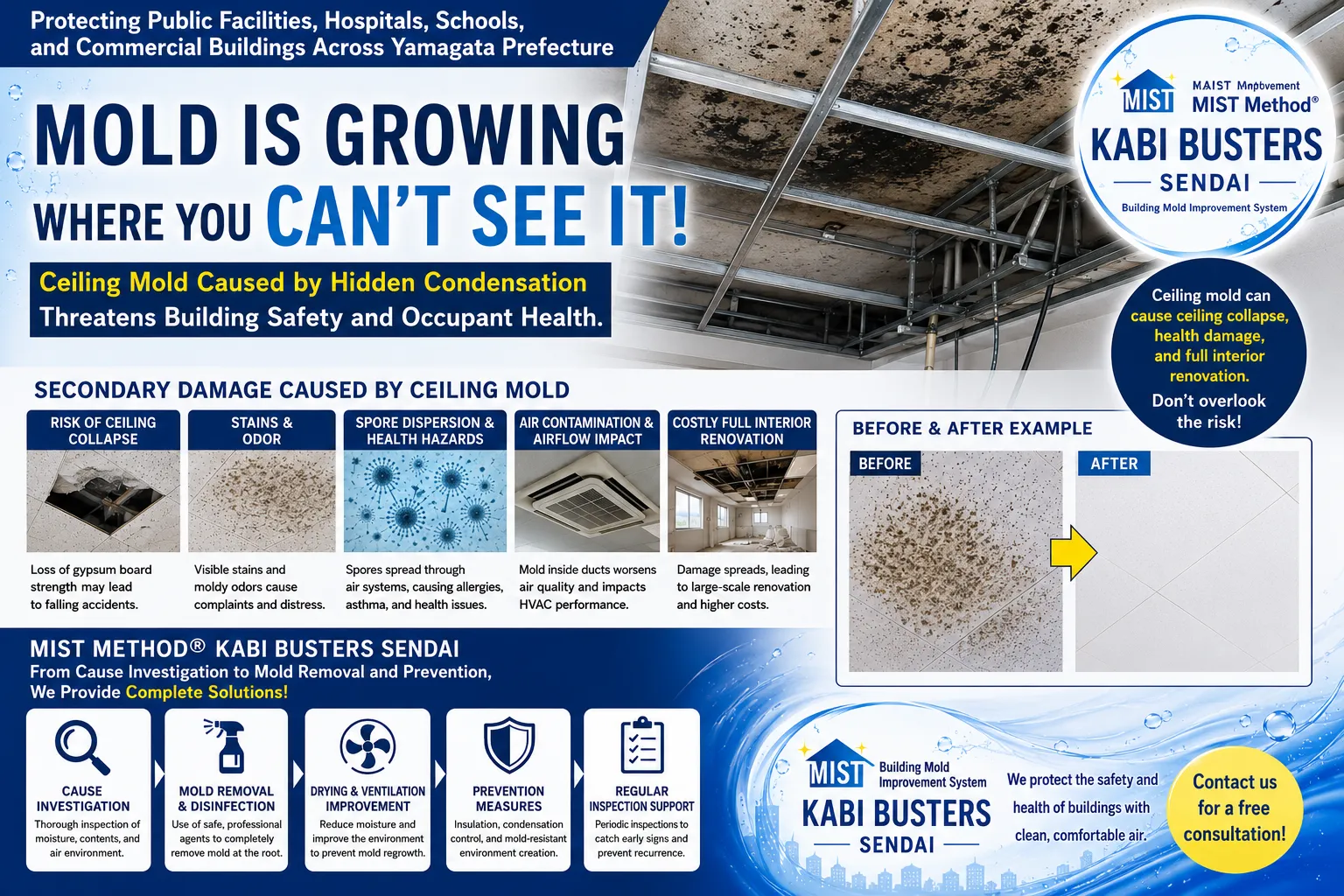
Gyptone ceilings are a common type of decorative gypsum board used in many facilities, but they are susceptible to moisture. In particular, if condensation occurs in the ceiling space for a long period of time, moisture accumulates inside the gypsum board, and mold that grows inside will reduce the strength of the board itself. In the initial stages, it may only be a small stain, but it is not uncommon for fungal hyphae to have spread over a wide area inside.
Even more dangerous is that ceiling materials infested with mold continue to release large amounts of spores. In hospitals, this can lead to health problems for patients; in schools, it can worsen coughs, rhinitis, and allergies among students and teachers; and in commercial facilities, it can lead to complaints about unpleasant odors and hygiene issues. In particular, in ceilings close to air conditioning systems, there is a risk that spores will spread throughout the entire facility through air circulation, so it is extremely dangerous to leave it as just "visible dirt."
Furthermore, the longer mold problems in gypsum board ceilings are left untreated, the more extensive the repair work becomes. In some cases, minor issues can be resolved with partial repairs, but if internal corrosion progresses, it can escalate to the complete removal of the ceiling, replacement of insulation, replacement of the light ceiling framing, and large-scale interior renovations. In particular, gypsum board that has remained in a high moisture content state will deteriorate in its crystalline structure, becoming brittle and prone to crumbling, and the risk of ceiling collapse cannot be ruled out.
MIST Method® Mold Busters Sendai offers comprehensive services beyond simple surface cleaning, including investigating the cause of condensation inside the ceiling space, measuring moisture content, investigating internal mold, performing mold and disinfection work, and implementing measures to prevent recurrence. We take into account the unique climate conditions of Yamagata Prefecture, and we check the ventilation, insulation, and air conditioning balance of each facility to create an environment that is less prone to recurrence.
"There are more stains on the ceiling lately," "The air conditioner smells musty," "There's condensation in the ceiling cavity," "The gypsum board is warping"—these symptoms may be signs that dangerous corrosion is progressing inside the building. Because these are places you can't see, early inspection and professional intervention greatly affect the lifespan and safety of the building.
目次
1. What is the mold problem inside gypsum board ceilings that is increasing in Yamagata Prefecture?
Winter heating and temperature fluctuations are causing "invisible condensation in the ceiling," which is spreading serious internal damage throughout the entire facility.
In Yamagata Prefecture, mold problems occurring inside gypsum board ceilings have been rapidly increasing in recent years, particularly in public facilities, hospitals, schools, and commercial buildings. A major concern is that "the abnormality is difficult to see from the surface." In many cases, by the time users or managers notice, widespread mold growth has already occurred inside the ceiling space, causing serious secondary damage to the building's interior.
Gyptone is a widely used building material for decorative ceilings, consisting of gypsum board, and is adopted in many large facilities such as schools, hospitals, government buildings, commercial facilities, and offices. While it is lightweight, easy to install, and offers a good balance of cost and performance, it is extremely susceptible to moisture. In particular, in areas like Yamagata Prefecture, where heating is used for long periods in winter and there is a large temperature difference between the outside air and the inside, a large amount of condensation is likely to occur inside the ceiling space.
For example, in winter, heating generates warm air indoors. This warm air flows into the ceiling cavity and, upon contact with the cold roof surface or exterior walls, causes condensation due to the sudden temperature difference. If this condition persists for a long period, moisture accumulates inside the gypsum board, in the light steel framing, insulation, joists, and around the suspension bolts, allowing mold to grow.
Furthermore, Yamagata Prefecture faces serious problems unique to snowy regions. Snowfall easily lowers the roof surface temperature, leading to a greater temperature difference between the roof and the interior of the attic. In addition, the increased airtightness of buildings in recent years makes it difficult for moisture to escape, which also contributes to accelerating internal condensation. Public facilities, in particular, have insufficient ventilation; hospitals have temperature and humidity differences due to 24-hour air conditioning; and schools have their ventilation stopped during long holidays. These facility-specific conditions combine to increase the risk of mold growth.
In hospitals, mold spores that have grown inside the ceiling can spread into the room via air conditioning, posing a health risk to patients and medical staff. Poor air quality is a particularly significant problem in wards used by patients with weakened immune systems. Furthermore, in schools, there has been an increase in cases of moldy odors, coughs, and rhinitis symptoms occurring in classrooms, music rooms, libraries, and gymnasiums, raising concerns about the impact on children and students.
The damage is also serious in commercial facilities. Mold that grows in back rooms or attics can spread as an odor into the sales area, leading to complaints such as "it smells musty" or "the air is heavy." In particular, in food-related facilities, it can develop into a hygiene management problem, and there is a risk that it will directly lead to damage to the company's image and business losses.
Furthermore, the mold problem inside gypsum board ceilings is not merely a hygiene issue. Gypsum board that has been exposed to moisture for a long period of time deteriorates its internal crystalline structure and gradually loses its strength. In the early stages, it may only be a matter of stains or sagging, but if left untreated, the board will become brittle and there is a risk that it will eventually lead to a ceiling collapse accident. In fact, there are many cases in which ceiling materials have collapsed during inspections, or corrosion has progressed around the suspension bolts.
A further problem is that simply cleaning the surface does not provide a fundamental solution. In many cases, mold has spread to the back of the ceiling material, inside the insulation, and into the light steel framing, so commercial detergents or surface wiping alone cannot stop the internal contamination. On the contrary, improper cleaning can cause a large amount of spores to be dispersed, spreading the contamination throughout the entire facility.
At MIST Method® Mold Busters Sendai, we provide comprehensive services, from condensation surveys inside ceilings, moisture content measurements, and internal mold investigations, to mold removal and disinfection work, and measures to prevent recurrence, all while taking into account the unique climate and building structure of Yamagata Prefecture. Because these are places that are not visible, early detection and specialized internal countermeasures are crucial for protecting the lifespan of the building and the safety of its occupants.
2. Why does condensation occur in the attic?
The unique snowfall, heating, and high humidity environment of Yamagata Prefecture are generating a large amount of moisture in the unseen space above the ceiling.
One of the biggest reasons for the increase in mold problems inside gypsum board ceilings in Yamagata Prefecture is "condensation in the ceiling space." In many facilities, only the ceiling surface can be inspected, so the presence of moisture and water droplets inside goes unnoticed for a long time, resulting in large-scale mold growth and corrosion of the ceiling material. Yamagata Prefecture, in particular, is a region where temperature fluctuations, snowfall, and humidity tend to coincide, making it an environment where condensation in the ceiling space is very likely to occur.
Condensation is the phenomenon where water vapor in the air turns into water droplets when it comes into contact with a cold surface. The same principle that causes water droplets to form on windowpanes in winter also occurs inside buildings, specifically in the ceiling space. A particular problem arises when warm, humid indoor air penetrates the ceiling cavity and comes into contact with the cold roof surface or structural elements. In Yamagata Prefecture, the long hours of heating use in winter result in extremely large temperature differences between the inside and outside, making this condensation phenomenon very likely to occur.
For example, hospitals and elderly care facilities need to maintain high room temperatures even in winter. Furthermore, the use of humidifiers and the constant coming and going of people can easily increase indoor humidity. When this warm, humid air flows into the attic through areas around light fixtures, pipe penetrations, inspection hatches, and ceiling gaps, condensation occurs rapidly due to the temperature difference with the cold roof surface. This process repeats daily, creating a constantly damp environment inside the attic.
Another major contributing factor is the unique "snowy environment" of Yamagata Prefecture. When it snows, the roof surface temperature tends to drop drastically, and the cold outside air affects the building for extended periods. As a result, the temperature difference between the roof and the inside of the attic and ceiling space becomes even larger, making it easier for condensation to occur in larger quantities than in other regions. This effect is particularly pronounced in older public facilities and schools with insufficient insulation.
Furthermore, in recent years, the increased airtightness of buildings has also become a factor in increasing internal condensation. While improved airtightness is effective in terms of energy saving, it also makes it more difficult for moisture to escape to the outside, causing it to accumulate inside. In buildings with insufficient ventilation design or air circulation balance, moisture concentrates in the ceiling space, creating localized areas of high humidity.
In school facilities, it's not uncommon for heating to be used during the winter months without adequate ventilation. Furthermore, during nighttime and long holidays, the sudden drop in temperature due to the shutdown of air conditioning can cause significant condensation to form inside the ceiling space. Music rooms, libraries, and audiovisual rooms, in particular, are highly airtight and prone to moisture buildup, so extra caution is needed.
In commercial facilities and supermarkets, steam generated from kitchens and prepared food areas also poses a problem. Water vapor produced during cooking can flow into the ceiling cavity due to imbalances in the air conditioning system, causing condensation in the back rooms and above the sales floor ceilings. In particular, around ceiling cassette air conditioners, the temperature difference between heating and cooling operations makes it easy for localized high humidity conditions to form.
Furthermore, poorly installed insulation is another problem that cannot be overlooked. If there are gaps, misalignment, or deterioration in the insulation, outside temperatures can easily penetrate directly into the ceiling. As a result, certain areas become extremely cold, leading to localized condensation. This type of localized condensation is prone to being discovered late because it concentrates on the back of the ceiling material or a portion of the light-gauge ceiling framing, causing mold to grow there.
What's even more frightening is that condensation creates a humid environment that provides the perfect conditions for mold growth. Mold thrives in environments with humidity above 70%, moderate temperatures, and a sufficient supply of nutrients. Gypsum board ceilings and gypsum boards have fine organic matter and dust particles attached to them, making it easy for mold to take root once they absorb moisture. The mold that grows inside then releases a large number of spores, spreading contamination to the surrounding area.
At MIST Method® Mold Busters Sendai, we don't just look at surface mold; we prioritize investigating the cause of condensation in that particular location. We comprehensively analyze moisture content measurements, temperature and humidity surveys, insulation conditions, and air conditioning airflow checks, and address the issue by implementing environmental improvements that make recurrence less likely. In areas with large temperature fluctuations, such as Yamagata Prefecture, simple cleaning alone is not enough to provide a fundamental solution. Understanding the "invisible moisture" occurring inside the building is the first step in true mold prevention.
3. The reality of mold growth progressing inside gypsum board ceilings
"Internal contamination in the ceiling space," which progresses without any visible abnormalities on the surface, is spreading serious corrosion damage throughout the entire building.
The most dangerous aspect of mold problems in gypsum board ceilings is that they "progress silently in unseen places." In many facilities, the problem is only noticed when small stains or discoloration appear on the ceiling surface. However, in reality, at that point, widespread mold growth is often already underway behind the gypsum board, in the light steel framing, insulation, and around the pipes. In particular, in areas like Yamagata Prefecture, where there are large temperature fluctuations and winter condensation is common, moisture tends to accumulate inside gypsum board ceilings for extended periods, leading to serious internal corrosion.
Gyptone is a ceiling material primarily composed of gypsum, but its surface is coated with a paint layer or decorative finish. Therefore, even if moisture has penetrated the interior in the initial stages, it can be difficult to detect any abnormalities from the surface. However, moisture gradually accumulates inside the gypsum board, creating an ideal high-humidity environment for mold growth. Furthermore, dust and organic matter from the air accumulate in the space above the ceiling, providing an abundant source of nutrients for mold.
Particularly dangerous is "internal condensation" that occurs inside the ceiling space. Warm, humid air generated by heating enters the ceiling space and condenses into water droplets upon contact with the cold roof surface or exterior wall. If this condensation remains on the back of the gypsum board for a long period, the moisture penetrates deep into the gypsum board, allowing mold hyphae to take root and rapidly proliferate.
In actual inspection sites, it's not uncommon to find that even if the ceiling surface looks relatively clean, black mold spreads across the entire surface the moment the inspection hatch is opened. Areas around light ceiling framing and suspension bolts are particularly prone to temperature differences and localized condensation, making them susceptible to mold growth. Furthermore, if moisture penetrates the insulation material, mold will continue to grow inside, creating a vicious cycle that degrades the insulation performance itself.
A further problem is that mold that has grown inside continues to release large amounts of spores. In many cases, the space above the ceiling contains air conditioning, ventilation equipment, and ducts, so there is a risk that the spores will spread throughout the entire facility by the airflow. In hospitals, the spores can spread to patient rooms and waiting rooms; in schools, to classrooms and libraries; and in commercial facilities, to sales areas, potentially leading to health problems for users and staff.
Mold spores, in particular, are extremely tiny and invisible to the naked eye. However, when large quantities of them float in the air, they can cause symptoms such as cough, rhinitis, sore throat, worsening allergies, headaches, and fatigue. In hospitals, there are concerns about the impact on patients with weakened immune systems, making this a problem that cannot be dismissed as a simple building issue.
Furthermore, mold inside gypsum board can cause the building material itself to deteriorate. Gypsum board that has been exposed to moisture for a long period of time will gradually lose its internal crystalline structure. Gypsum board, which should normally maintain a certain level of strength, becomes brittle due to deterioration caused by moisture and mold, making it prone to cracking, deformation, and sagging. If the corrosion progresses further, the screw fixings and the areas around the hanging brackets will also weaken, and ultimately there is a risk of the ceiling collapsing.
In fact, in Yamagata Prefecture, there have been cases where investigations into seemingly minor issues like "a stain on the ceiling" revealed extensive corrosion requiring the complete replacement of insulation, or widespread rust and corrosion of the light-gauge ceiling substrate. Judging solely by the surface can lead to overlooking serious internal damage.
Furthermore, it's crucial to be aware of the incorrect approach of using commercially available mold removers or simple cleaning methods. Wiping only the surface will not remove the fungal hyphae that have taken root on the underside and inside. In fact, vigorous scrubbing or blowing air can scatter large amounts of spores, potentially spreading contamination throughout the entire facility. Moreover, simply improving the appearance with bleach will not solve the problem, as the risk of recurrence remains very high as long as internal moisture persists.
At MIST Method® Mold Busters Sendai, we place great importance not only on inspecting the surface of the gypsum board ceiling, but also on investigating the internal conditions. We conduct inspections of the access points, measure moisture content, check the insulation, and conduct air quality surveys to understand the extent of internal contamination before proceeding with construction. In Yamagata Prefecture's unique environment of extreme temperature fluctuations and heavy snowfall, "invisible internal countermeasures" are extremely important. Mold is not just a problem on the visible parts. The real danger lies in the internal corrosion and spore contamination that silently progresses behind the surface.
4. Risk of reduced gypsum board strength leading to ceiling collapse accidents.
Condensation and high humidity silently cause "invisible deterioration," which can lead to sudden ceiling collapses.
One of the most serious problems with mold inside gypsum board ceilings is the "risk of ceiling collapse due to weakened gypsum board strength." Many people associate ceiling mold with "unsightly appearance" or "foul odor." However, in reality, the major problem is that internal condensation and prolonged humidity cause the gypsum board itself to deteriorate, losing its strength as a building material. In particular, in areas like Yamagata Prefecture, where snowfall, temperature fluctuations, and heating environments combine, the moisture content inside the ceiling space tends to rise, and there are many cases where dangerous corrosion is progressing in unseen places.
Gypsum board is a building material that inherently possesses a certain degree of strength. However, it is susceptible to moisture. When it absorbs moisture for a long period due to internal condensation, the crystalline structure within the gypsum gradually breaks down. Initially, this may only result in minor deformation or small stains, but internal weakening progresses, and the board itself becomes "soft" and "brittle."
Particularly dangerous is the continuous condensation that occurs inside the ceiling space. Warm air from winter heating enters the ceiling space and comes into contact with the cold roof surface and building structure, causing water droplets to repeatedly adhere to the back of the gypsum board. If this condition continues for several months to several years, the gypsum board will always be in a state of high moisture content, and its strength will rapidly deteriorate.
In public facilities and schools in Yamagata Prefecture, investigations initiated by complaints such as "the ceiling is slightly sagging" or "stains are spreading" have revealed cases where the gypsum board inside has become so brittle that it crumbles by hand. Furthermore, there are many cases where rust and corrosion are progressing around the suspension bolts and on the metal parts of the light ceiling framing, indicating that not only the ceiling material but also the structure supporting the ceiling itself is weakened.
Furthermore, gypsum board becomes heavier when it absorbs moisture. This increases the weight beyond what it was originally designed for, placing a significant load on the hanging brackets and screw fasteners. As a result, cracks and deformation gradually develop around the fasteners, ultimately leading to the risk of the board falling off.
The places at particularly high risk are "facilities where many people gather," such as hospitals, schools, and commercial facilities. If ceiling materials were to fall, it could lead to serious injuries. In schools, there are concerns about harm to children and students; in hospitals, to patients and medical staff; and in commercial facilities, to customers. Because deterioration inside the ceiling space is not normally visible, it is not uncommon for abnormalities to go unnoticed until just before an accident occurs.
Another problem is that gypsum board deterioration often progresses "partially." For example, corrosion can progress extremely rapidly only in areas where condensation is concentrated locally, such as around air conditioners, pipe penetrations, and areas with insulation defects. Therefore, even if the problem appears minor from the outside, a dangerous condition may be spreading internally.
A further problem is that mold growth accelerates the deterioration of gypsum board. Mold thrives not only on moisture but also on organic matter and fine dust as nutrients. It uses dirt attached to the surface and back of the gypsum board to spread its hyphae and penetrate into the interior. This hyphae activity accelerates material deterioration, making the surface coating more likely to peel off and the board more prone to crumbling.
In actual cases, we frequently see situations where people think, "It's just a stain, so it's okay," or "There was a smell, but I left it alone." However, investigations often reveal that the damage has progressed to the point where it requires complete replacement of insulation, replacement of the light ceiling framing, or even complete removal of the ceiling. In particular, buildings that have been left unattended for a long period of time may require a complete interior renovation, which can significantly increase construction costs.
It's also important to understand that commercially available dehumidifiers and simple cleaning alone won't provide a fundamental solution. Even if surface humidity is temporarily reduced, the moisture content will rise again if the temperature difference and condensation causes inside the attic are not addressed. Furthermore, once the gypsum board deteriorates internally, it will not recover naturally once its strength has begun to decline.
At MIST Method® Mold Busters Sendai, we don't just remove mold; we conduct investigations from the perspective of whether the building materials are in a condition that can maintain safety. We comprehensively perform moisture content measurements, deflection checks, gypsum board deterioration diagnoses, and light steel frame corrosion checks, and provide renovation proposals as needed.
In regions with large temperature fluctuations, such as Yamagata Prefecture, condensation in ceilings is an unavoidable problem. However, with early detection and appropriate measures, it is possible to minimize damage before it develops into a serious accident. Visible stains and odors are not merely superficial problems. Behind them, dangerous deterioration that could lead to ceiling collapse may be silently progressing.
5. Secondary damage: stains, foul odors, and spore dispersion spread throughout the entire facility.
Mold that originated in the ceiling space has spread throughout the building via the air conditioning system, leading to health problems and the need for extensive renovations.
Mold problems occurring inside gypsum board ceilings are not simply a matter of "dirty ceilings." The most serious issue is that mold growing inside the ceiling space releases large amounts of spores, which then spread throughout the entire facility via air conditioning and ventilation systems. In public facilities, hospitals, schools, and commercial buildings in Yamagata Prefecture, this "invisible spore contamination" is increasingly leading to health problems, unpleasant odors, and even the need for complete interior renovations.
In the initial stages, only small stains may appear on the ceiling surface. However, these stains are a sign that moisture generated by internal condensation is seeping through the gypsum board to the surface. In other words, by the time abnormalities are visible on the surface, widespread mold growth may already be underway on the other side.
In particular, the inside of gypsum board ceilings is a place where air conditioning ducts, wiring, ventilation equipment, and insulation are concentrated, making it easy for mold to spread throughout the entire facility once it starts to grow. When the air conditioning system is running, spores floating inside are carried by the airflow to each room, spreading contamination to a wide area including classrooms, hospital rooms, offices, sales floors, and corridors.
This is a particularly serious problem in hospital facilities. Mold spores are extremely small and invisible to the naked eye. However, if they become airborne in large quantities, they pose a risk of causing health problems for patients and healthcare workers. Patients with weakened immune systems are especially at risk of respiratory symptoms, worsening allergies, and an increased risk of infection. If you notice a "slight musty smell" in a waiting room or ward, the cause is often located inside the ceiling.
The same applies to school facilities. Complaints such as "increased coughing," "rhinitis symptoms," and "heavy air" are sometimes reported in classrooms, music rooms, and libraries. Children and students, in particular, are more susceptible to environmental changes than adults, and prolonged inhalation of spores can lead to health problems. Furthermore, chronic sore throats and headaches among teachers and staff, among other issues stemming from poor air quality, cannot be overlooked.
In commercial facilities, unpleasant odors directly translate into business risks. If customers perceive a musty or damp smell in the sales area, it can lead to decreased customer satisfaction and complaints. This is especially problematic in food-related facilities, as it can damage trust in hygiene management. Even if you think the problem is limited to the back rooms or attics, the air conditioning system can spread odors and spores throughout the entire facility.
What's even more frightening is that spore contamination can trigger a chain reaction of "secondary damage." Spores scattered from the ceiling can adhere to the back of wallpaper, under flooring, inside furniture, curtains, documents, and wood, causing new mold growth. In other words, mold in one spot inside the ceiling can, over time, contaminate the air quality throughout the entire building.
In Yamagata Prefecture in particular, the combination of winter heating and heavy snowfall creates prolonged periods of high humidity, providing ideal conditions for spores to easily re-propagate once they have attached. As a result, partial repairs are often insufficient, and in many cases, the problem escalates to large-scale interior renovations, including the complete removal of ceilings, replacement of insulation, complete replacement of wallpaper, and replacement of light-weight ceiling framing.
In actual cases, what started as "just a small stain" or "a slight odor" has escalated to the point of requiring a complete facility renovation a few years later. In particular, in buildings where inspections are inadequate, mold growth in the ceiling space can be left unattended for extended periods, spreading contamination to the inside of the air conditioning system, sometimes necessitating duct cleaning and even complete disassembly and cleaning of the air conditioners.
Furthermore, damage is often exacerbated by incorrect cleaning methods. Simply spraying commercially available mold removers or wiping only the surface will not prevent the internal fungal hyphae from remaining. Moreover, strong ventilation or drying can cause a large amount of spores to be dispersed, potentially accelerating the contamination of the entire facility.
At MIST Method® Mold Busters Sendai, we don't just remove surface contaminants; we focus on the "entire air environment." We conduct internal inspections, moisture content measurements, air environment checks, and air conditioning path checks to understand the extent of spore contamination before carrying out mold removal and disinfection work.
In regions with large temperature fluctuations, such as Yamagata Prefecture, mold growth inside the building due to condensation in the ceiling space is not an uncommon problem. However, if left untreated, it can escalate beyond mere stains and odors to include health problems, damage to the facility's image, major renovations, and even the risk of business closure. Small abnormalities occurring in the unseen ceiling space are the most urgent warning signs that should be addressed as quickly as possible to protect the entire building.
6. MIST Method® Mold Busters Sendai's specialized countermeasures for Gyptone ceilings
We provide comprehensive services, from thorough inspections of unseen areas like the ceiling space to mold removal, disinfection, and condensation prevention.
The increasing mold problem inside gypsum board ceilings in Yamagata Prefecture cannot be fundamentally solved by simple cleaning or surface treatment alone. This is because actual mold growth is very often not in the "visible parts," but in hard-to-see places such as the inside of the ceiling, insulation, light steel framing, and around air conditioning systems. MIST Method® Mold Busters Sendai emphasizes "comprehensive construction" that goes from investigating the cause to mold removal, disinfection, and prevention of recurrence in order to address this kind of internal contamination.
The first and most important step is investigating the cause to determine "why mold has grown in that particular location." In Yamagata Prefecture, temperature fluctuations, snowfall, and heating conditions make internal condensation common, and simply checking the surface won't reveal the true cause. Therefore, our company conducts inspections of access points, visual checks of the ceiling space, moisture content measurements, and temperature and humidity checks to thoroughly determine how much moisture is accumulating inside.
Of particular importance is checking the condition of the inside of the gypsum board and the insulation. Even if the surface of a gypsum board ceiling looks clean, black mold may be growing all over the back. Also, if moisture has penetrated the insulation, a vicious cycle may occur where condensation worsens due to a decrease in insulation performance. At MIST Method® Mold Busters Sendai, we place importance on understanding the condition of the "invisible interior" as well as what is visible.
Furthermore, checking the air conditioning system and ventilation routes is also crucial. In hospitals, schools, and commercial facilities, spores can spread throughout the entire facility due to air conditioning airflow. Therefore, simply treating the ceiling materials is insufficient, and the risk of recurrence increases if the air quality is not adequately improved. Our company also checks the mold growth around the air conditioning system and the locations where condensation occurs, and we offer internal cleaning and airflow improvement suggestions as needed.
Our mold removal process does not involve simple bleaching or surface cleaning. This is because even if the surface appears white, there is a very high probability of recurrence if fungal hyphae remain inside. With the MIST® method, we proceed with mold removal using methods that are less likely to damage gypsum board or light-weight ceiling substrates, while checking the condition of the material and the level of contamination.
Gypsum board ceilings, in particular, are susceptible to material damage from excessive water use or vigorous scrubbing. Therefore, we handle them carefully during construction, taking into consideration the stress on the building materials. Furthermore, measures to prevent spore dispersion during construction are extremely important. If a large amount of spores are dispersed due to improper work, there is a risk of spreading contamination throughout the entire facility. At our company, we prioritize safety and proceed with the work while taking measures to protect the construction area and suppress spore dispersion.
After mold removal, we also carry out disinfection and deodorization measures. Mold that has grown inside the ceiling for a long period of time can produce a distinctive musty odor. This odor not only causes strong discomfort to users but also leads to the image of the facility as having "poor air quality." In hospitals, schools, and commercial facilities, improving the air environment itself is an important part of facility management, so measures that include odor control are necessary.
Even more important is "measures to prevent recurrence." Simply removing mold is not enough. If underlying causes such as internal condensation or poor ventilation remain, moisture will be generated again, and mold may grow in the same place. MIST Method® Mold Busters Sendai checks for insufficient insulation, ventilation conditions, air conditioning balance, and moisture accumulation, and provides improvement proposals tailored to each facility.
For example, if the cause is insufficient ventilation in the attic, we propose ventilation improvements; if it's due to insulation defects, we propose insulation repairs; and if it's due to uneven airflow from the air conditioning system, we propose airflow adjustments or operational improvements. We implement preventative measures tailored to the building structure. It's not just about being a "cleaning company," but about taking a perspective that improves the building environment itself.
Furthermore, in public facilities and hospitals, there are many cases where "business operations cannot be stopped" or "construction must be carried out while users are present." At our company, we take into consideration the operating conditions of the facilities and offer flexible solutions such as nighttime construction, area-by-area construction, and safety measures.
In regions like Yamagata Prefecture, where temperature fluctuations and heavy snowfall are severe, condensation inside attics may increase further in the future. However, early inspections and appropriate internal countermeasures can significantly improve building lifespan and air quality.
MIST Method® Mold Busters Sendai doesn't just treat visible mold; it thoroughly investigates "why it occurred" and "how to prevent recurrence," providing comprehensive construction that protects the entire building.
7. Preventive management methods necessary for the long-term protection of buildings in Yamagata Prefecture
We're entering an era where simply removing the problem and being done with it is no longer enough—continuous management of the attic environment is key to preventing recurrence.
The increasing mold problem inside gypsum board ceilings in Yamagata Prefecture cannot be completely resolved with just one mold removal treatment. This is because the real cause of mold growth is an environment where moisture easily accumulates inside the building. In particular, in areas like Yamagata Prefecture, where snowfall, temperature fluctuations, heating use, and high humidity conditions coincide, condensation is likely to occur inside buildings, and if left untreated, there is a risk of mold growth again. Therefore, in order to protect buildings in the long term, the concept of "preventive management" is extremely important.
First and foremost, the most important thing is "condensation prevention." Most mold that grows inside gypsum board ceilings is caused by condensation inside the ceiling space. Warm indoor air from the heating system enters the ceiling space and comes into contact with the cold roof or exterior wall surface, causing water droplets to form. This moisture then accumulates in the gypsum board and insulation. If this condition persists, the problem will recur no matter how much surface cleaning is done.
In Yamagata Prefecture in particular, the winter heating season is long, resulting in a very large temperature difference between indoors and outdoors. Therefore, the first thing that is needed is to take measures to prevent moisture from entering the attic. For example, it is very common to see warm air entering through gaps around inspection hatches, around lighting fixtures, and through pipe penetrations. By properly sealing these areas, the risk of condensation can be greatly reduced.
Furthermore, reviewing the insulation environment is also important. Gaps or deterioration in insulation materials can cause localized temperature differences, leading to localized condensation. In particular, many older public facilities and schools have been found to have misaligned or insufficient insulation. Maintaining proper insulation performance can prevent a rapid drop in temperature inside the ceiling space, thus suppressing condensation.
Next in importance is "improving ventilation." Modern buildings are becoming increasingly airtight, making it easier for moisture to accumulate inside. Hospitals, schools, and commercial facilities, in particular, generate a large amount of moisture due to the constant flow of people and the use of heating. However, if the ventilation balance is poor, this moisture accumulates inside the building, accelerating condensation in the ceiling space.
For example, in school facilities, ventilation is sometimes turned off during the winter to combat the cold. However, if ventilation is insufficient for an extended period, the humidity inside the classroom will rise, and that moisture will easily flow into the space above the ceiling. Similarly, in hospital facilities, indoor humidity tends to be high due to the use of humidifiers, making proper air conditioning balance management extremely important.
Improving ventilation isn't simply a matter of "turning on the exhaust fan." It requires a comprehensive consideration of factors such as the balance between supply and exhaust air, airflow, and the direction of air conditioning airflow. In particular, it's crucial to manage the air circulation throughout the entire building to prevent moisture buildup in the attic space.
Furthermore, regular inspections are essential for protecting buildings in the long term. Many facilities where mold problems become serious tend to have delayed detection of abnormalities. Because the inside of the ceiling space is not normally visible, by the time symptoms such as "odors" or "stains" appear, internal corrosion has often already progressed significantly.
Therefore, it is important to conduct regular inspections of access points, check moisture content, and monitor air quality to enable early detection and countermeasures. In particular, in Yamagata Prefecture, humidity levels change significantly with each season, such as during snowmelt, the rainy season, and when humidity rises in the summer. By conducting inspections and management in accordance with seasonal changes, it becomes easier to prevent the spread of damage.
Regular cleaning of air conditioning equipment is also extremely important. If mold and dust accumulate inside the air conditioning system, it can cause spores to spread throughout the entire facility. The area around ceiling cassette air conditioners is particularly prone to condensation and is a high-risk area for mold growth. Regular disassembly and cleaning, as well as filter maintenance, can prevent the deterioration of the air quality.
Furthermore, facility managers' awareness of humidity is also crucial. For example, not neglecting ceiling stains, not underestimating moldy smells, and promptly checking for air conditioning malfunctions—in many cases, large-scale damage can be prevented by responding to small changes early on.
At MIST Method® Mold Busters Sendai, we don't just focus on simple mold removal; we prioritize creating a building environment that is less prone to recurrence in the long term. Taking into account the unique temperature fluctuations and snowfall environment of Yamagata Prefecture, we propose comprehensive preventative management that includes condensation countermeasures, ventilation improvements, insulation checks, and regular inspections.
The mold problem is no longer something you can deal with "after it happens." To maintain buildings safely and for the long term, "preventive management" will become increasingly important. Regularly checking the unseen environment in the ceiling and controlling humidity is the most important point for protecting buildings in Yamagata Prefecture in the long term.
----------------------------------------------------------------------
カビバスターズ仙台
MPソリューション株式会社
〒980-0013
宮城県仙台市青葉区花京院2-1-61
オークツリー仙台1F
電話番号 090-8957-8975
----------------------------------------------------------------------